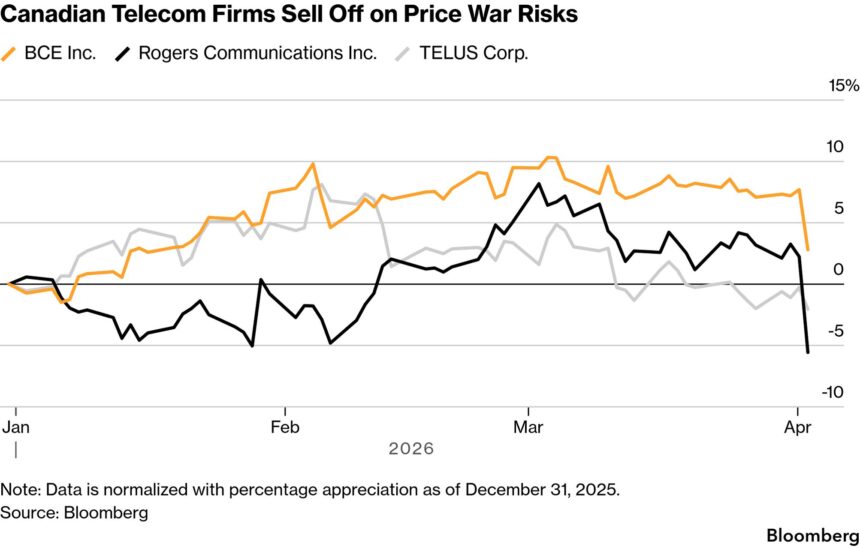
Canadian telecom stocks have transitioned from reliable income generators to volatile assets as major carriers slash dividends to combat rising debt and shrinking margins.
This shift marks a fundamental change for investors who once viewed the sector as a safe haven, signaling that the era of guaranteed growth in the Canadian wireless market has concluded.
The decline of these once-stable equities highlights the risks of relying on debt-funded expansion in a market now defined by intense price competition and regulatory oversight.
The erosion of the dividend model
For over a decade, Canadian telecom stocks were considered essential holdings for income-focused portfolios. Investors enjoyed consistent dividend growth supported by a protected oligopoly that faced minimal competition. Source: The Globe and Mail.
That model began to fracture in 2025. BCE slashed its dividend following years of stock price declines and mounting debt loads, according to data from Seeking Alpha.
The trend continued into 2026. Telus cut its quarterly dividend by 55% in July 2026, reducing the annual payout to $0.75 per share, as reported by The Motley Fool.
Management at these firms cited the need to prioritize debt reduction over maintaining historical dividend levels. This decision broke a long-standing expectation among Canadian investors who viewed these payouts as sacrosanct.

Market pressures and revenue declines
The financial performance of the major carriers has faced significant headwinds throughout 2026. Intense price competition, largely driven by Videotron following its acquisition of Freedom Mobile, has squeezed margins.
According to reports from PlanHub, average monthly mobile revenue per user declined by 2.6% at Rogers and 1.7% at Bell during the third quarter of 2026.
The industry is also grappling with rising costs for 5G and AI infrastructure. A 2026 report by the GSMA warned that Canada’s telecom policy framework is at an inflection point, with revenues plateauing while capital requirements continue to climb.
Rogers has responded to these pressures by targeting a 30% reduction in capital expenditure for 2026, aiming for a range of C$2.5 to C$2.7 billion to manage its debt, according to industry analyst Frank Rayal. Source: The Motley Fool.
Consolidation as a last resort
The industry’s struggle for profitability has led to speculation regarding further consolidation. In November 2026, Quebecor publicly announced an unsolicited telus takeover proposal, valuing the company at approximately C$19.45 per share.
Investors have reacted with skepticism to this bid, reflecting the significant regulatory hurdles involved. If the market believed the deal was likely to succeed, the share price reaction would be far more pronounced.
The federal government has spent years fostering greater competition to improve affordability for consumers. It is unlikely that policymakers would approve a merger that threatens these gains.
The following factors define the current state of the sector:
Dividend cuts are now a primary tool for debt management. Capital expenditure budgets are being slashed to preserve cash flow. Average revenue per user is falling due to aggressive pricing from smaller competitors. Regulatory bodies remain focused on consumer affordability over industry consolidation. The historical oligopoly model is failing to adapt to modern market demands.
The sector’s glory days seem like a distant memory.
The Globe and Mail
Analysis of the sector outlook
The argument for avoiding telecom stocks rests on the structural shift away from high-margin growth. The era of easy profits driven by limited competition is over, and the debt-funded expansion of the last decade has left balance sheets fragile.
Conversely, some analysts argue that these companies remain essential infrastructure providers. As the backbone of the digital economy, they provide recurring revenue that is difficult to replicate in other sectors.
While the current valuations are lower, they may present a long-term opportunity for investors who prioritize network scale. Consolidation could eventually lead to a more efficient, albeit smaller, group of players. Source: GSMA.
However, the risk of further dividend cuts remains high. Investors must decide if the potential for a rebound outweighs the current reality of austerity and regulatory friction.
Next steps for investors
If you currently hold telecom stocks, review your portfolio’s exposure to the sector. Assess whether your investment thesis relies on dividend growth that is no longer guaranteed.
Monitor the ongoing discussions regarding the bce and telus infrastructure strategies. Understanding how these companies plan to manage their debt while investing in new technology is vital for long-term holding.
Consider diversifying your income holdings outside of the telecom sector. Look for industries with less regulatory exposure and more flexible pricing power.
If you are considering buying at current lower valuations, focus on companies with the strongest balance sheets and the lowest debt-to-equity ratios. Avoid chasing high yields that may be subject to future cuts.
Frequently Asked Questions
Why did Telus cut its dividend?
Telus cut its dividend to prioritize debt reduction and manage the financial pressures of high capital expenditures for network expansion.
Is the Quebecor bid for Telus likely to succeed?
Market reaction suggests skepticism, as there are significant regulatory hurdles and the federal government is unlikely to approve a deal that reduces competition.
Are telecom stocks still safe for income investors?
Telecom stocks are no longer considered safe income plays, as recent dividend cuts by major carriers have demonstrated that payouts are subject to change based on financial performance.