



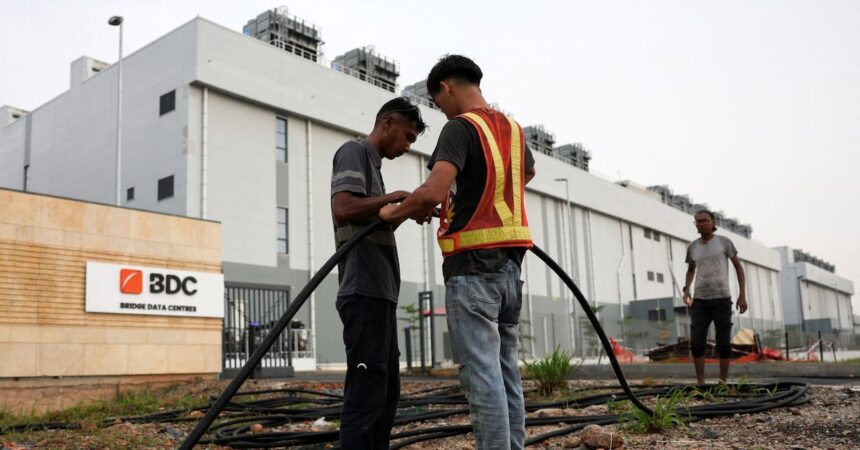
La Caisse de dépôt et placement du Québec is in advanced negotiations to acquire a significant stake in Bain Capital’s Bridge Data Centres. The potential deal for the Singapore-based operator could carry a valuation between $4 billion and $5 billion.
This investment represents a strategic pivot for the Canadian pension manager as it seeks to diversify its portfolio away from saturated North American markets. The move underscores a growing appetite for high-growth digital assets in emerging economies.
Investors must weigh the potential for rapid expansion against the complex operational risks inherent in the Asian market. Success in this sector requires navigating power constraints and regulatory hurdles that differ significantly from domestic projects.
The mechanics of the Bain Capital exit
Bain Capital is currently exploring a partial exit from its investment in Bridge Data Centres, which it first acquired in 2017. Sources indicate the firm is considering selling approximately 50 percent of the business while retaining a minority stake to benefit from future growth. Source: Reuters.
The auction process has attracted interest from several major institutional players. Beyond La Caisse, entities such as GIC, SK Telecom, and Sixth Street Partners have been identified as potential suitors for the platform.
Bridge Data Centres has demonstrated significant momentum in the region. In March 2025, the company successfully secured $2.8 billion in bank financing to accelerate its hyperscale development projects across its core markets.
The valuation range of $4 billion to $5 billion reflects the premium currently placed on established data centre platforms in Asia, a theme also seen in the BCE and TELUS AI data centre strategies. These facilities are essential for supporting the region’s rapidly expanding digital economy and artificial intelligence requirements.

Diversification into emerging market infrastructure
CDPQ has a history of investing in data centre assets, though its previous focus remained largely centered on North America. In March 2026, the pension fund invested CAD 240 million in Cologix’s MTL8 data centre in Montreal.
The shift toward Asian markets is driven by projected capacity growth in the region. According to Allianz Commercial, data centre capacity in the Asia Pacific region, excluding China, is expected to grow from 9GW to over 28GW by 2030.
This growth trajectory provides a compelling case for institutional investors seeking long-term yield. By partnering with an established operator like Bridge Data Centres, CDPQ can bypass some of the initial development risks associated with entering new territories.
However, the move also exposes the fund to the volatility of emerging markets. Managing multi-market construction projects requires deep local expertise and a sophisticated approach to supply chain management.
Options for institutional digital asset exposure
Investors looking to replicate the strategy of large pension funds like La Caisse have several avenues for gaining exposure to the sector. These options range from direct equity investments in private platforms to broader infrastructure funds. Source: Mingtiandi.
The following list outlines key approaches for gaining exposure to the data centre market, reflecting the types of assets currently drawing institutional capital.
1. Hyperscale Platform Partnerships: Investing alongside private equity firms in established platforms like Bridge Data Centres offers direct exposure to high-growth regions. These platforms benefit from long-term contracts with major cloud service providers.
2. Specialized Infrastructure REITs: Real Estate Investment Trusts focused on data centres provide a liquid alternative to private equity. These vehicles allow investors to benefit from the recurring revenue generated by colocation and interconnection services.
3. Power and Cooling Technology Providers: The growth of data centres is constrained by energy availability. Investing in companies that provide advanced cooling systems or renewable energy solutions for data centres captures the supply chain side of the industry.
4. Regional Infrastructure Funds: Many institutional investors participate through dedicated infrastructure funds that pool capital to develop assets in specific geographies. This approach provides diversification and professional management of regulatory risks.
Investment in emerging market data centers faces risks including power shortages, water supply strains, and complex regulatory environments.
International Finance Corporation
Analysis of the strategic pivot
The potential investment by La Caisse in Bridge Data Centres is a calculated bet on the digital transformation of the Asian economy. By moving into these markets, CDPQ is hedging against the risk of oversupply in North American data centres.
Critics might argue that the move introduces unnecessary geopolitical and operational complexity. Managing construction projects in India or Thailand involves navigating varying regulatory frameworks and potential power grid instability that could delay project timelines.
Despite these risks, the sheer scale of the projected demand in Asia makes the investment thesis difficult to ignore. The transition to AI-ready infrastructure requires massive capital deployment that only large pension funds can provide. Source: IFC.
CDPQ’s strategy remains sound as long as it maintains a disciplined approach to asset selection. Partnering with a proven operator like Bain Capital provides a layer of protection through established operational processes and existing client relationships.
Next steps for individual investors
For individual investors, direct access to private data centre platforms is often limited to accredited or institutional channels. You should review your current portfolio to determine your existing exposure to digital infrastructure through broader real estate or technology holdings.
Consider researching publicly traded data centre REITs if you seek liquid exposure to the sector. Evaluate these companies based on their geographic footprint, power capacity, and their ability to secure long-term leases with hyperscale tenants.
Monitor the regulatory environment in the regions where these data centres are expanding. Changes in local energy policies or data sovereignty laws can significantly impact the long-term profitability of these assets.
Finally, consult with a financial advisor to ensure that any new allocation to infrastructure aligns with your overall risk tolerance and investment horizon. Infrastructure assets typically require a long-term commitment to realize their full value.
Frequently Asked Questions
Why is La Caisse looking at Asian data centres?
CDPQ is seeking to diversify its portfolio and capture the high growth projected for digital infrastructure in Asia, which is expected to see significant capacity expansion by 2030.
What are the primary risks of this investment?
Key risks include power shortages, water supply constraints, and the complexities of managing construction projects within diverse regulatory environments in emerging markets.
Will Bain Capital retain any ownership in the company?
Yes, Bain Capital is considering selling approximately 50 percent of the business while retaining a minority stake to participate in future growth.