The Canadian real estate market recorded a 2.3% decline in national home sales during September 2026. This downturn occurred as the Bank of Canada raised its policy interest rate to 2.5% in October 2026.
This shift reflects a broader economic cooling that threatens to deepen the nation’s long-term housing supply deficit. Launch Len Media views this period as a critical risk to future inventory levels despite the temporary leverage gained by some buyers.
Interest Rates and Sales Volume
The Bank of Canada implemented a policy interest rate hike to 2.5% in October 2026. This decision was explicitly linked to the central bank’s mandate to manage persistent inflation, according to reports from CTV News.
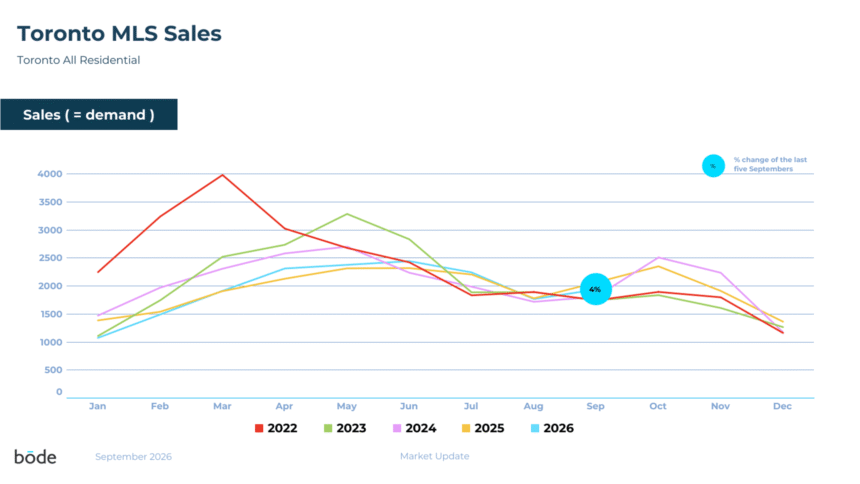
The impact on the Canadian real estate market was immediate. Data from the Canadian Real Estate Association (CREA) shows that national home sales declined by 2.3% in September 2026.
This decline follows a pattern of weakening demand observed throughout the year. The reduction in sales volume suggests that buyers are increasingly sensitive to the rising cost of debt.
New listings also fell by 1.8% in September 2026. This downward trend in inventory has been consistent since early 2025, complicating the market recovery process.

Price Trends and Regional Disparities
The MLS Home Price Index (HPI) recorded a 3.4% decline on a year-over-year basis as of September 2026. This figure highlights the downward pressure on property values across the country.
Regional differences remain a defining feature of the current landscape. Ontario and British Columbia are experiencing the most significant downward pressure on prices.
Other provinces are showing signs of slowing growth rather than outright contraction. This divergence suggests that the national average masks localized volatility.
The ongoing housing correction is particularly pronounced in urban centers where affordability was already stretched. Analysts note that these areas are struggling to find a price floor.
Strategic Options for Market Participants
Buyers currently navigating the market have more negotiation power than in previous years. The reduction in competition allows for more due diligence during the purchase process.
Investors looking at the pre-construction sector may find specific opportunities in Ontario. Some buyers are shifting toward these projects as an alternative to the volatile resale market.
Homeowners facing financial distress should evaluate their mortgage terms before renewal. The rise in arrears rates indicates that some households are struggling to manage current debt levels.
Those considering a sale should account for the current inventory trends. With new listings falling, properties that are priced competitively may still attract interest despite the broader slowdown.
- Prioritize fixed-rate mortgage options to hedge against further rate volatility.
- Focus on regions with resilient growth if seeking long-term capital appreciation.
- Leverage the current buyer’s market to negotiate closing costs and inspection conditions.
- Monitor the pre-construction market for potential value relative to existing resale homes.
The Supply Gap and Long-Term Risks
The Canada Mortgage and Housing Corporation (CMHC) has identified a significant structural supply crisis. The agency estimates an annual housing supply gap of 187,000 to 238,000 units.
This deficit must be addressed to restore pre-pandemic affordability by 2036. Current construction slowdowns are expected to exacerbate this issue in the coming years.
Launch Len Media maintains that the current market downturn poses a severe risk to long-term supply. If developers continue to pause projects due to high costs, the inventory shortage will worsen.
Some analysts argue that this painful rebalancing is necessary to reset market expectations. They suggest that the current environment provides a needed correction after years of unsustainable growth.
The long-term annual housing supply gap is estimated at 187,000 to 238,000 units to restore pre-pandemic affordability by 2036.
Canada Mortgage and Housing Corporation
Financial Stability and Mortgage Arrears
Financial stability among homeowners is a growing concern for policymakers. Ontario’s mortgage arrears rate reached 0.32% in the second quarter of 2026.
This figure is expected to climb through mid-2027 as more homeowners face renewal at higher interest rates. The accumulation of consumer debt and credit card delinquencies adds further pressure.
Larger and newer mortgages are experiencing the fastest increases in delinquency rates. This trend suggests that recent entrants to the market are the most vulnerable to economic shifts.
The combination of rising debt and high interest rates creates a precarious environment for many households. Policymakers are closely watching these metrics to assess the risk of systemic instability.
Frequently Asked Questions
Why are home sales declining in Canada?
Home sales are declining primarily due to high interest rates, which have increased borrowing costs and dampened buyer demand.
What is the current status of the housing supply gap?
CMHC estimates a structural annual supply gap of up to 238,000 units, which remains a significant challenge for long-term affordability.
Are mortgage arrears increasing?
Yes, Ontario reported a 0.32% mortgage arrears rate in Q2 2026, with expectations for further increases as more homeowners face high-interest renewals.