



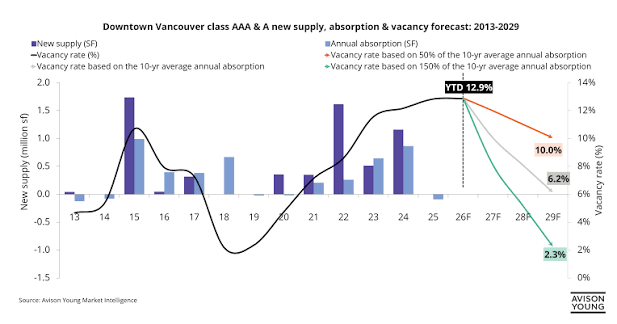
Downtown Vancouver office vacancy climbed to 13.1 percent in the third quarter of 2026, marking the highest level recorded in 22 years. The spike follows Amazon’s decision to consolidate its workforce into The Post complex, leaving significant gaps in the city’s commercial inventory.
This shift signals a broader instability in the downtown commercial real estate market, where a flight to quality leaves older office stock struggling to compete. Launch Len Media views this transition as a pivotal moment that may force a permanent change in how the city utilizes its aging vertical real estate.
The Impact of Amazon’s Consolidation
Amazon’s move into the North Tower of The Post has fundamentally altered the downtown landscape. The company began occupying nearly 600,000 square feet of space in March 2026, according to Daily Hive reporting.
This consolidation resulted in 250,000 square feet of office space becoming vacant across two major downtown buildings. Specifically, 160,000 square feet opened up at the Telus Garden tower, while 90,000 square feet became available at The Exchange.
More than 1,000 employees have already relocated to the new facility. The move is part of an incremental phase of occupancy that began in 2023 when the South Tower of The Post was completed.
CBRE data confirms that the downtown vacancy rate jumped from 12.2 percent in the second quarter to 13.1 percent in the third quarter. This level of vacancy has not been seen since the recovery period following the dot-com bubble burst.

The strain is not limited to offices: see how Telus data centres exit signals a major Canadian market correction and how housing starts compare with supply targets.
Regional Disparities in Office Tenancy
The vacancy crisis remains concentrated within the downtown peninsula rather than the wider region. Metro Vancouver’s overall office vacancy rate rose more modestly from 11.7 percent to 12.2 percent during the same period.
Suburban markets outside of the downtown core saw vacancy rates rise only slightly, from 11.2 percent to 11.3 percent. This marks the sixth straight quarter where downtown vacancy has outperformed suburban metrics in terms of negative growth.
CBRE analysts noted that the regional market would have likely remained stable if not for the specific impact of the Amazon consolidation. The downtown core accounted for approximately 235,000 square feet of the total 259,000 square feet decline in tenancy across the region.
Despite these figures, Metro Vancouver’s vacancy rate remains below the national average of 16.7 percent. This suggests that while the downtown core faces a specific supply issue, the broader region maintains a higher level of relative health.
Options for Repurposing Stranded Assets
Property owners are currently evaluating the feasibility of converting vacated office space into alternative uses. The high vacancy rates at premium towers like Telus Garden and The Exchange have prompted discussions regarding hotel and residential conversions.
The following options represent the current landscape for these stranded assets:
1. Hotel Conversions: Owners are assessing if the floor plates of older towers can support hospitality layouts. This would address the city’s need for more visitor accommodation.
2. Government Bids: The vacated space is being positioned as part of a bid to host the federal Defence, Security and Resilience Bank. Submissions for this project are due in December 2026.
3. Sublease Markets: Space at The Exchange is currently available for sublease through 2035. This provides a temporary solution for firms seeking Class AAA space at potentially discounted rates.
4. Residential Retrofitting: While structurally challenging, some developers are looking at the feasibility of converting office towers into residential units to help mitigate the housing crisis.
The current market office rents are too low to cover the cost of building a new office tower in Downtown Vancouver.
CBRE Market Bulletin
Market Analysis and Future Outlook
Launch Len Media argues that the current vacancy surge is a symptom of a ‘flight to quality’ trend. Tenants are increasingly abandoning older, less efficient buildings in favor of modern, sustainable complexes like The Post.
This trend creates a bifurcated market. While premium, sustainable space remains in high demand, older office stock faces an existential threat that may lead to permanent repurposing.
Some analysts argue that this consolidation is a necessary evolution. By centralizing operations, companies reduce their carbon footprint and improve operational efficiency, which is a net positive for the city’s long-term sustainability goals.
However, the counterpoint remains that the sudden influx of vacant space puts downward pressure on commercial property values. This could lead to a period of financial instability for owners of older office towers who lack the capital to renovate or convert their assets.
Next Steps for Commercial Tenants
If you are a business looking for office space in Vancouver, the current market offers significant leverage. With vacancy at a 22-year high, tenants have more room to negotiate lease terms in older Class A buildings.
You should prioritize buildings that have been recently retrofitted for modern energy standards. While the downtown core is seeing high vacancy, the lack of new supply until 2032 means that well-maintained older buildings will likely remain the primary option for years.
Consider exploring suburban markets if your operations do not require a downtown presence. Areas like Burnaby and New Westminster are seeing new inventory come online, such as the fourth phase of the SOLO District, which offers competitive leasing opportunities.
Finally, monitor the progress of the CF Waterfront Tower project. As the only major active office development in the downtown pipeline, it will serve as a bellwether for the future of the city’s central business district.
Frequently Asked Questions
Will there be new office buildings in downtown Vancouver soon?
No. CBRE expects no new office supply in the city centre before 2032 due to current rent levels being too low to justify construction costs.
Why is the vacancy rate so high?
The rate is primarily driven by Amazon consolidating its operations into The Post complex, which left 250,000 square feet of office space vacant in other downtown towers.
Is the vacancy issue affecting all of Metro Vancouver?
No. The vacancy surge is concentrated in the downtown core, while suburban markets have seen much smaller, more stable increases in vacancy.