Canada housing starts currently track at a pace sufficient to absorb projected 2027 population growth, according to recent analysis from Rentals.ca.
While this alignment prevents immediate demand shocks, the nation remains burdened by a structural supply deficit of 571,000 units that continues to limit long-term affordability.
Launch Len Media views this as a fragile stabilization that requires sustained policy focus, as current construction levels are inadequate to resolve the deep-seated housing shortage.
Current Construction and Population Absorption
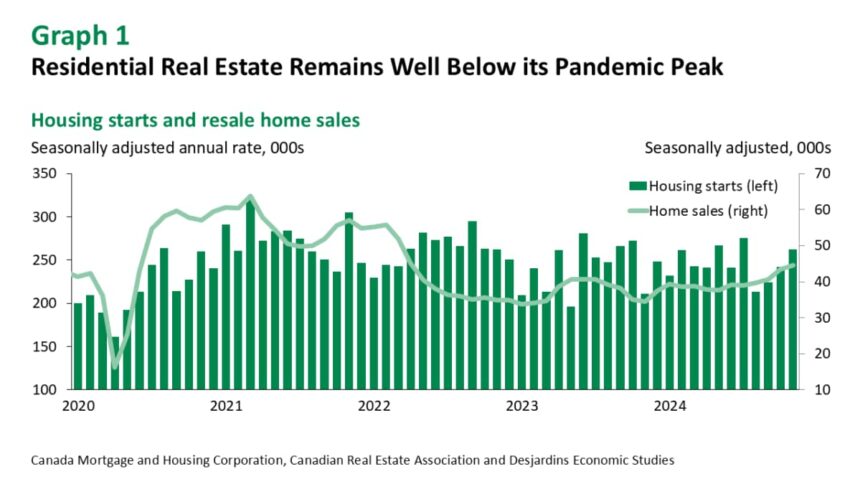
The national pace of residential construction reached approximately 240,000 units per year as of November 2026, according to data from the Canada Mortgage and Housing Corporation (CMHC). This volume provides an absorption capacity for roughly 500,000 new residents annually. Source: Rentals.ca.
This capacity aligns with the federal government’s updated immigration plan for 2027 to 2029. The plan limits permanent resident admissions to 380,000 per year while accounting for temporary resident transitions.
Because many transitions involve individuals already living in Canada, the net population growth is expected to stay within the 177,000 to 440,000 range. This forecast falls below the 500,000-person capacity of current construction models.
Despite this balance, the national trend in housing starts declined by 1.7% in October 2026 to 246,231 units. This fluctuation highlights the sensitivity of the construction sector to interest rates and market sentiment.

The Persistent 571,000 Unit Deficit
While 2027 growth appears manageable, the cumulative supply gap remains a significant hurdle for the Canadian economy. The deficit peaked at 780,000 units in mid-2024 before narrowing to approximately 571,000 units by mid-2026.
The CMHC Fall 2026 Housing Supply Report indicates that Canada requires 187,000 to 238,000 additional homes per year beyond current levels to restore pre-pandemic affordability by 2036.
Closing this deficit under a low-growth scenario would require nearly four years of construction above population requirements. Under high-growth scenarios, the timeline extends beyond a decade.
Mathieu Laberge, Chief Economist at CMHC, warned that stopping construction in response to softer market conditions creates future shortages. He emphasized that current production levels are failing to match the specific types of housing Canadians need.
Budget 2026 Policy Interventions
Budget 2026 introduced several measures intended to stimulate production and address the structural deficit. The government proposed a $13 billion capital increase for Build Canada Homes to accelerate affordable housing construction.
To further encourage new development, the budget exempts new residential properties from the federal foreign buyer ban. This change aims to attract investment into the construction pipeline.
Kevin Fettig of CMI Financial Group noted that these reforms could improve financing access for smaller developers. However, he cautioned that municipal zoning and approval delays remain significant bottlenecks.
The following list summarizes the key policy levers currently being utilized to address the housing crisis:
1. $13 billion capital injection for the Build Canada Homes program.
2. Exemption of new residential builds from the federal foreign buyer ban.
3. Streamlined financing pathways for small-scale residential developers. Source: CMHC.
4. Targeted efforts to align municipal zoning with federal housing density goals.
5. Increased focus on purpose-built rental construction to improve vacancy rates.
We are at a very high risk that by not providing the appropriate and sufficient supply today, we will lose the improvement in affordability we’ve seen two or three, or five years down the road.
Mathieu Laberge, Chief Economist and Senior Vice President at CMHC
Market Analysis and Future Risks
Launch Len Media maintains that while the 2027 immigration targets are technically absorbable, the housing market remains in a precarious position. The focus on short-term absorption ignores the reality that the structural deficit continues to suppress affordability.
A fair counterpoint suggests that aggressive supply-side interventions, such as those included in Budget 2026, may face significant delays. Municipal zoning bottlenecks and persistent labor shortages often prevent federal funding from translating into physical units on the ground.
Furthermore, the collapse in condo presales is expected to reduce completions in 2028 and 2029. This decline will likely tighten vacancy rates, which have already begun to climb back up in major markets like Toronto and Vancouver.
The current improvement in affordability is fragile. As newly permanent residents form households, demand will likely outpace the current construction pipeline, potentially reversing the rent declines seen over the past 25 months.
Next Steps for Market Participants
If you are a prospective buyer or investor, monitor the progress of local municipal zoning reforms. Federal funding is only effective if local authorities approve the projects in a timely manner.
Brokers should prepare for a shift in client needs as newly permanent residents enter the mortgage market. These individuals are likely to accelerate household formation, increasing the demand for entry-level housing.
Investors should remain cautious regarding the rental market. While vacancy rates are currently above historical averages, the projected decline in completions for 2028 and 2029 suggests that supply relief may be temporary.
Finally, prioritize properties that align with current demand trends. As CMHC noted, the market suffers from a mismatch where small units are unaffordable and large units are unavailable, making targeted investment critical.
Frequently Asked Questions
Why is the housing supply gap still 571,000 units if construction is sufficient for 2027?
The 571,000 unit figure represents a cumulative deficit built up during the 2022-2024 period. While current construction can handle 2027 growth, it does not build enough extra units to clear the existing backlog.
How does the foreign buyer ban exemption affect new construction?
The exemption allows foreign capital to flow into new residential developments, which can provide necessary liquidity for developers to start new projects. This is intended to boost new housing supply in a high-interest rate environment.
What is the primary risk to housing affordability in the coming years?
The primary risk is a mismatch between the housing being produced and the housing needed, combined with a potential slowdown in construction completions due to recent declines in condo presales.
Related reading: multi-family permit slowdown, immigration plan shift, mortgage cost pressure.