A new survey from the Canada Pension Plan Investment Board reveals that most Canadians are failing to account for increased life expectancy in their CPP retirement planning. While 76% of citizens acknowledge that people are living longer, only 34% have incorporated this reality into their long-term financial strategies.
This disconnect creates a critical vulnerability for millions of Canadians who risk outliving their savings. Launch Len Media views this gap as a systemic failure to bridge the divide between basic saving habits and the complex requirements of modern longevity.
The 2026 Retirement Longevity Survey Findings
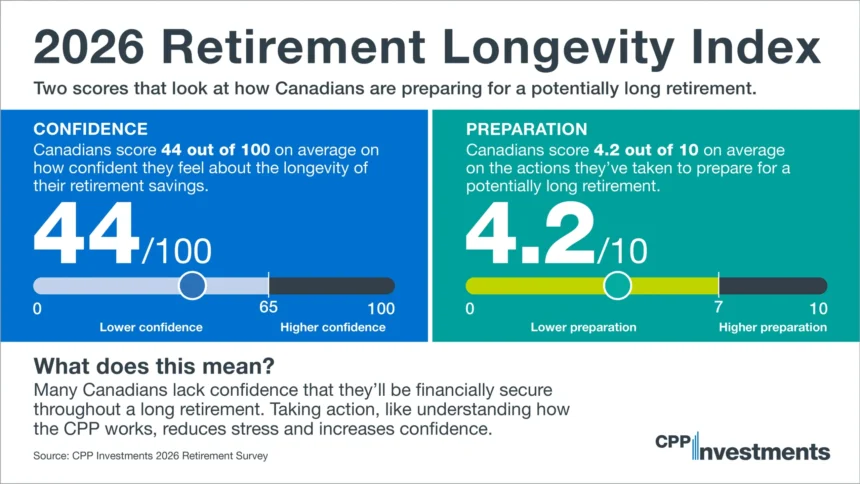
The 2026 CPP Investments Retirement Survey, which polled 5,141 Canadians, highlights a stark reality regarding the nation’s financial readiness. According to the report, the average confidence score regarding retirement security sits at a low 44 out of 100. Source: Financial Post.
The data shows that while 75% of Canadians have set aside some money for the future, only 42% possess a formal financial plan. A significant 34% of respondents are actively saving without any structured strategy in place.
Michel Leduc, senior managing director at CPP Investments, noted that there is a clear gap between awareness and action. He emphasized that living longer requires a fundamental shift in how individuals approach their retirement portfolios.
The survey also found that 40% of people have never discussed the expected length of their retirement. Among those who could provide an estimate, the median expectation was 20 years, yet many admitted their current finances would only cover half that duration.
Living longer changes the way we need to think about retirement. Putting money aside is an important start. But planning also means thinking about how long retirement could last, the sources of income you may have, and how those pieces fit together.
Michel Leduc, CPP Investments
The Mechanics of the Longevity Gap
The financial vulnerability stems from a mismatch between expected lifespan and actual funding. For many, the lack of a formal plan leads to a reliance on guesswork rather than actuarial reality.
The survey data indicates that individuals who take concrete steps to prepare for a long retirement report a confidence score of 58 out of 100. In contrast, those who do not engage in such planning report a confidence score of only 35 out of 100.
The Office of the Chief Actuary of Canada confirmed in May 2026 that the CPP remains financially sustainable over a 75-year projection period. However, this sustainability applies to the fund itself, not the individual savings of Canadians.
The gap is further widened by the fact that 34% of Canadians report high day-to-day financial stress. This figure climbs to 47% for households earning less than $50,000, making long-term planning a secondary concern to immediate survival.
Options for Strengthening Your Retirement Strategy
To bridge the gap between current savings and future needs, experts suggest several actionable approaches. These options focus on moving from passive saving to active management of your retirement portfolios.
The following list provides specific paths for those looking to improve their financial preparedness.
Each option is designed to address the specific longevity concerns identified in the 2026 survey. Source: CPP Investments.
- Engage a certified financial planner to conduct a comprehensive longevity analysis.
- Utilize tax-advantaged accounts to maximize the growth potential of your long-term assets.
- Review your CPP and OAS projections to understand your guaranteed income floor.
- Adjust your contribution rates to account for a retirement period potentially exceeding 25 years.
- Consolidate fragmented savings accounts to gain a clearer view of your total retirement readiness.
Analysis of the Planning Disconnect
The primary issue is not a lack of effort, but a lack of structure. Many Canadians treat retirement as a savings goal rather than a multi-decade income management project.
Launch Len Media argues that the current approach is insufficient because it ignores the compounding impact of inflation and increased healthcare costs over a longer life. Without a formal plan, individuals are flying blind into their most vulnerable years.
Critics might argue that for many Canadians, the focus on long-term planning is an unrealistic expectation. With rising costs of living and stagnant wage growth, immediate financial survival must take precedence over retirement longevity.
While this counterpoint is valid, it does not negate the necessity of planning. Even small, incremental steps toward a formal strategy can significantly improve financial outcomes and reduce the long-term burden on the public purse.
Next Steps for Financial Security
If you are among the 58% of Canadians who are unsure if they have enough money to support retirement, you must start by auditing your current assets. You should identify exactly how many years of income your current savings can realistically provide.
Next, you should seek professional financial planning advice to stress-test your assumptions about longevity. This process will help you determine if your current savings rate is sufficient to meet your long-term goals.
Finally, you should prioritize your debt management and savings contributions to ensure that you are not sacrificing your future for present-day consumption. Small adjustments made today can prevent significant financial shortfalls in the future.
Frequently Asked Questions
Is the Canada Pension Plan at risk of running out of money?
No. The Office of the Chief Actuary of Canada confirmed in May 2026 that the CPP is financially sustainable over a 75-year projection period.
Why does having a formal plan increase confidence scores so significantly?
A formal plan provides a clear roadmap, which reduces the anxiety associated with the unknown. It allows individuals to see how their assets will cover their expenses over a longer lifespan.
What is the biggest mistake Canadians make regarding retirement?
The biggest mistake is failing to account for how long retirement will actually last. Most people underestimate their lifespan, which leads to insufficient savings.