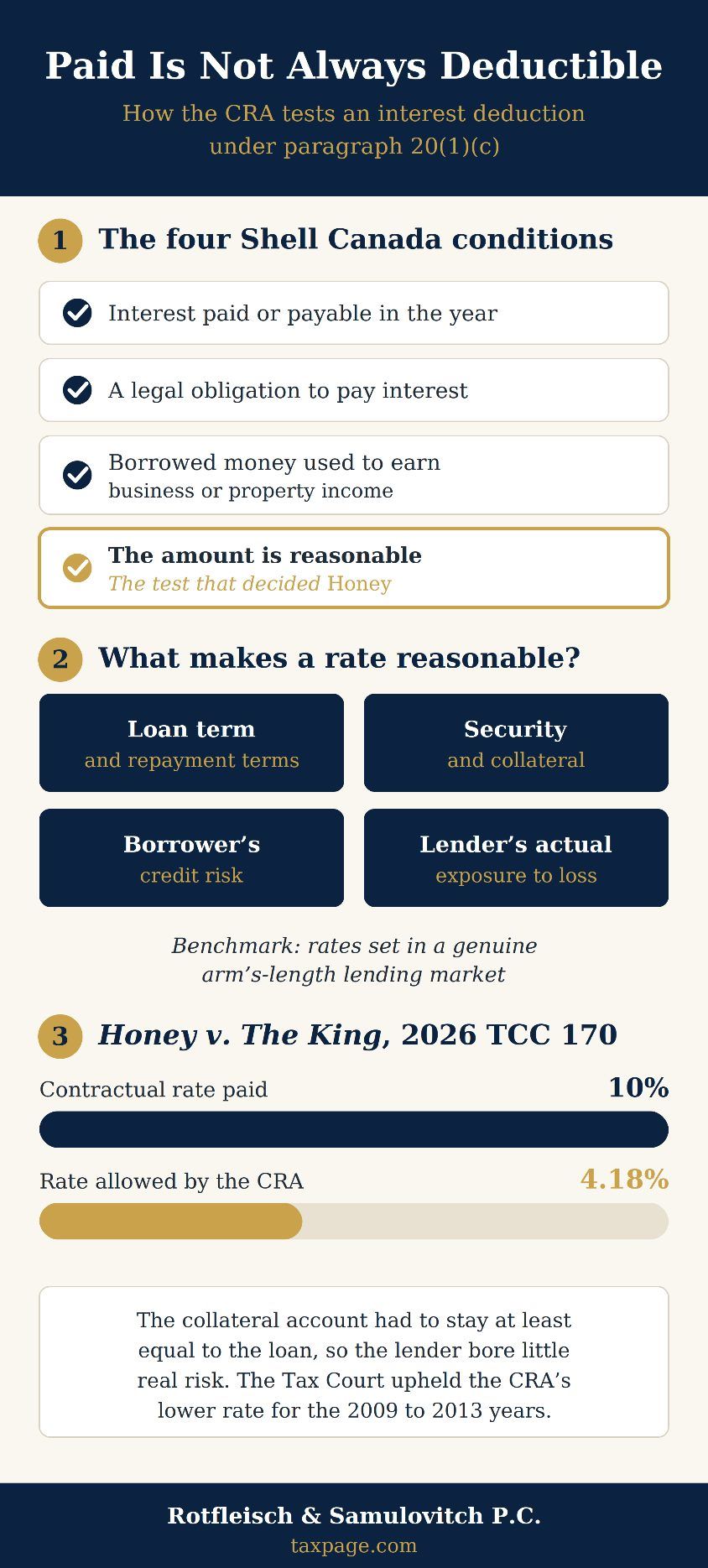
The Tax Court of Canada decision in Honey v. The King signals a definitive end to the era where taxpayers could rely on siloed contract defenses to justify inflated interest rates in complex tax-planning arrangements. By restricting the CRA interest deduction for the Honey brothers from a contractual 10 percent down to a market-based 4.18 percent, the court has empowered the Canada Revenue Agency to look past the paper trail of individual agreements and examine the economic reality of the entire structure. The stakes for high-net-worth individuals and corporations are immense. If the CRA can successfully challenge the reasonableness of rates in 10/8 insurance arrangements, no tax-planning structure involving interlinked debt and investment is truly safe from similar scrutiny. This ruling confirms that the CRA is no longer content to accept the face value of contracts when those contracts appear designed primarily to generate outsized tax benefits. Related: CRA tax administration challenges
What happened
On September 15, 2026, the Tax Court of Canada delivered its judgment in Honey v. The King (2026 TCC 170). The case involved two taxpayers, Glenn and Greg Honey, who had entered into 10/8 life insurance arrangements. In these arrangements, funds deposited into a policy’s collateral investment account earned a guaranteed 8 percent, while an equal amount was borrowed against it at 10 percent, with the interest on the loan claimed as a tax deduction. For their 2009 to 2013 taxation years, the Honey brothers claimed interest deductions based on the 10 percent contractual rate. The CRA challenged this, arguing that the rate was not a “reasonable amount” under subparagraph 20(1)(c)(i) of the Income Tax Act (the CRA sets out its position in Income Tax Folio S3-F6-C1, Interest Deductibility). Justice Russell, presiding over the case, sided with the CRA. The court dismissed both appeals and upheld the reassessments, which limited the deduction to interest calculated at a reasonable rate of 4.18 percent. Central to the court’s reasoning was the rejection of the taxpayers’ argument that the insurance policy and the bank loan were separate, arm’s-length commercial transactions. The court found that the circular flow of funds made these non-arm’s length transactions, even though the brothers and the bank were unrelated parties. The judgment does not say how the CRA identified the taxpayers, but some commentators link the case to the CRA’s earlier Unnamed Persons Requirement against the insurer (MNR v. RBC Life Insurance Co., 2011 FC 1249, which the decision cites), pointing to the agency’s ability to track participants in these types of tax-planning arrangements. Related: Federal tax measures to boost investments
More Read

Why this matters
This decision matters because it dismantles the siloed contract defense that has long been a cornerstone of aggressive tax planning in Canada. For years, practitioners argued that if a contract stated a specific interest rate, the CRA had little room to challenge that rate as long as the contract was legally binding. Honey v. The King proves that the CRA can and will look through the legal form to the economic substance. The court’s decision establishes that the CRA interest deduction is not an absolute right but a conditional one, subject to the test of reasonableness. Some tax practitioners argue that this decision is highly fact-specific to 10/8 arrangements and should not be broadly applied to conventional Immediate Financing Arrangements that lack similar circularity. They contend that the ruling is limited to the specific evidence presented regarding the Honey brothers’ arrangement. However, this counterpoint ignores the broader trend of judicial deference to the CRA when it comes to identifying and dismantling tax shelters. The ruling provides a clear roadmap for the CRA to challenge other arrangements where the debt and the investment are inextricably linked. By ignoring the siloed defense, the court has effectively lowered the bar for the CRA to recharacterize interest payments as non-deductible or partially deductible expenses. This is not just a win for the tax authorities; it is a warning to every taxpayer who believes that a signed contract is a shield against the scrutiny of the tax man. The economic reality of the transaction now carries more weight than the ink on the page. Related: CRA disclosure rules
What readers should do
Taxpayers currently involved in complex financing arrangements or those considering such structures must take immediate steps to mitigate their risk. The landscape has shifted, and relying on past practices is no longer a viable strategy for tax compliance. You should consider the following actions to protect your financial position and ensure your tax filings remain defensible:
- Conduct a thorough review of all existing interest-bearing loan arrangements to ensure the rates charged align with current market conditions for similar, arm’s-length debt.
- Document the business purpose of your financing arrangements beyond the tax benefits, ensuring you have a clear, non-tax-related reason for the structure.
- Consult with a tax lawyer to assess whether your current arrangements could be viewed as non-arm’s length or circular by the CRA.
- Prepare for increased audit activity by organizing all correspondence and agreements related to your financing and investment structures in a single, accessible location.
- Evaluate the potential for voluntary disclosure if you identify any arrangements that may no longer meet the threshold of reasonableness established by the court.
By taking these steps, you can move from a reactive posture to a proactive one, ensuring that your tax planning is robust enough to withstand the scrutiny that the CRA is now clearly prepared to apply. Related: CRA GenAI chatbot
Frequently Asked Questions
Does this ruling mean all interest deductions are now at risk?
No. The ruling specifically addresses arrangements where the interest rate and the structure of the debt are tied to a non-arm’s length investment. Conventional, arm’s-length loans remain subject to standard tax rules.
What is the significance of the 4.18 percent rate?
The court determined this to be a reasonable, market-based rate for the type of risk involved in the transaction, contrasting it with the 10 percent rate claimed by the taxpayers.
Can the CRA use Unnamed Persons Requirements more often?
Unnamed Persons Requirements remain available to the CRA, with Federal Court authorization, to gather information on participants in specific tax-planning schemes. Commentators have linked the Honey case to an earlier requirement against the insurer, though the judgment itself does not say how the taxpayers were identified.