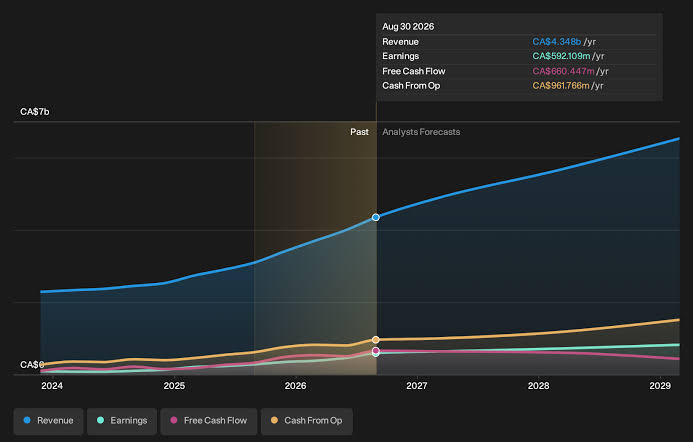
Aritzia stock remains a focal point for investors assessing the long-term performance of founder-led Canadian enterprises. Research indicates that companies managed by their founders often deliver superior shareholder returns compared to professionally managed peers.
This analysis examines the structural advantages and governance challenges inherent in founder-led business models. Investors must weigh the benefits of visionary leadership against the potential for concentrated decision-making power.
The Performance Gap of Founder-Led Firms
Bain & Company research covering the period between 2015 and 2025 found that founder-led companies in the S&P 500 outperformed non-founder-led counterparts by 2.1 times in total shareholder returns. This data suggests that the presence of a founder often aligns management incentives with long-term value creation.
Founder-led organizations are frequently characterized by a strategic orientation that prioritizes decades of growth over quarterly earnings targets. According to Chandrawat & Partners, this long-term focus allows firms to invest in innovation without the immediate pressure of short-term market fluctuations.
Aritzia, founded by Brian Hill in 1984, continues to operate under this philosophy with CEO Jennifer Wong. The company currently maintains a market capitalization of approximately CA$16.6 billion as it executes a five-year strategic plan.
The firm intends to reach up to C$10.5 billion in revenue by fiscal 2032. This ambitious target reflects the confidence of leadership in the brand’s ability to scale operations while maintaining its core identity.

Mechanics of Growth and Governance Risks
While the founder-led model offers growth potential, it introduces specific governance risks that investors must monitor. Pendal Group reports that potential issues include compromised boards, nepotism, and the use of dual-class voting structures.
Dual-class shares often allow founders to retain control even after their economic stake in the company decreases. This can disadvantage minority shareholders who may have limited say in major strategic decisions or board appointments.
Concentrated decision-making is another hallmark of these firms. While this allows for rapid execution of a vision, it also creates a dependency on the founder or their hand-picked successor. If the leadership transition fails, the company may face significant instability.
Investors should evaluate these risks against the company’s historical performance. A balanced view requires assessing whether the founder’s vision justifies the potential lack of traditional corporate checks and balances.
Top Founder-Led Canadian Stocks to Watch
Aritzia (TSX:ATZ) remains a prominent example of a founder-led retail success story. The company’s expansion strategy focuses on increasing its footprint in the United States and optimizing its digital presence to reach the C$10.5 billion revenue goal by 2032.
Lightspeed Commerce (TSX:LSPD) was founded by Dax Dasilva in 2005 and continues to play a significant role in the commerce software sector. The company reported fiscal 2026 revenue of US$1.23 billion, which represents a 13.95% increase year-over-year.
Xanadu Quantum Technologies (TSX:XNDU) represents the newer wave of founder-led innovation. Founded by Christian Weedbrook in 2016, it became the first pure-play photonic quantum computing company to list on public markets in March 2026.
Each of these companies demonstrates the founder-led trait of pursuing niche or emerging markets with high intensity. Investors should track these firms to see if their growth rates justify the premium often associated with founder-led stocks.
- Aritzia (TSX:ATZ): Focused on retail expansion and a C$10.5 billion revenue target by 2032.
- Lightspeed Commerce (TSX:LSPD): Showing 13.95% year-over-year revenue growth in fiscal 2026.
- Xanadu Quantum Technologies (TSX:XNDU): A pioneer in photonic quantum computing now accessible to public investors.
- Bain & Company findings: Founder-led firms outperformed peers by 2.1 times over a decade.
Analysis of the Founder Advantage
The argument for investing in founder-led companies rests on the concept of skin in the game. Founders who remain involved often possess a deeper emotional and financial commitment to the company’s success than professional managers who may prioritize short-term stock options.
Critics argue that this structure is inherently undemocratic. The potential for conflict of interest is high when a founder controls the board and the voting power. This can lead to decisions that benefit the founder at the expense of other shareholders.
LaunchLen Media maintains that the founder advantage remains a valid investment thesis provided the company has a robust board of directors. A strong independent board can mitigate the risks of concentrated power while allowing the founder to pursue a long-term vision.
The success of Aritzia demonstrates that when a founder-led company executes well, the results can be substantial. However, investors must perform due diligence on the specific governance structure of each firm before committing capital.
Founder-led companies are often characterized by a long-term strategic orientation, thinking in decades rather than quarters, which can foster innovation.
Chandrawat & Partners, 2026
Steps for Evaluating Founder-Led Investments
Investors should begin by reviewing the company’s proxy circular to understand the voting rights structure. Look specifically for dual-class shares that might limit the influence of common shareholders.
Analyze the board of directors to ensure there is a sufficient number of independent members. A board dominated by the founder’s associates may lack the necessary oversight to challenge management decisions effectively.
Compare the company’s long-term strategic goals against its recent financial performance. A company that consistently misses its own targets may be suffering from a lack of objective oversight or an overly ambitious founder.
Monitor the succession plan. A founder-led company is most vulnerable during leadership transitions, so understanding who will take over is essential for long-term holding strategies.
Frequently Asked Questions
What is the primary risk of investing in founder-led companies?
The primary risks include concentrated decision-making, potential conflicts of interest, and governance structures like dual-class voting that may disadvantage minority shareholders.
Why do founder-led firms often outperform?
They tend to have a long-term strategic orientation, thinking in decades rather than quarters, which fosters innovation and aligns management incentives with long-term growth.
How can I check if a company has a dual-class share structure?
You can find this information in the company’s annual report or proxy circular under the capital structure or share ownership section.
Related reading: TSX Market Performance Dips Amid Inflation and Leadership Changes, Top Undervalued Canadian Stocks to Consider for November 2026, Finding Value in Undervalued Canadian Stocks and Alphamin Resources, Bain & Company, TMX Group.