Recent progress in Canada-U.S. trade talks has signaled a potential shift in the economic landscape for Canadian homeowners. While a deal could stabilize the economy, analysts warn it may also lead to higher mortgage costs.
This analysis explores why resolving trade tensions might paradoxically force the Bank of Canada to increase interest rates. Understanding these mechanics is essential for managing your personal finances in the coming year.
The Current State of Trade Negotiations
Canada-U.S. trade talks have shown renewed momentum following a high-level meeting between Prime Minister Mark Carney and President Donald Trump at the G7 summit. Prime Minister Carney indicated that American negotiators are currently offering more while requesting fewer concessions than in previous rounds. Source: The Globe and Mail.
Economist Moshe Lander notes that while trade wars often stifle growth, they also create a climate of uncertainty that keeps interest rates artificially suppressed. Resolving these disputes removes that uncertainty, which allows the economy to heat up and inflation to rise.
The Bank of Canada has been operating under a wait-and-see approach for much of the year. Governor Tiff Macklem recently signaled that the bank must move cautiously, citing a lack of clarity regarding trade policy and potential tariffs as a primary reason for holding rates steady.
Prolonged trade uncertainty has kept many potential homebuyers on the sidelines, damaging overall consumer confidence. A definitive deal would likely restore market activity, but it would also remove the primary justification for the central bank to keep borrowing costs low.
Mechanics of Interest Rate Hikes
The Bank of Canada maintains a mandate to control inflation, typically targeting a two percent rate. When economic growth accelerates due to a trade deal, inflation often follows, necessitating interest rate hikes to cool the economy.
CIBC deputy chief economist Benjamin Tal suggests that removing the trade war from the equation would prompt the Bank of Canada to hike rates faster than previously expected. He notes that the bank would face heat from two directions: economic growth from a trade deal and persistent inflation from high oil prices.
Bond swap markets, which track investor sentiment regarding future monetary policy, have already priced in two or three more rate hikes by mid-2027. These expectations are likely to intensify if a comprehensive trade deal is finalized.
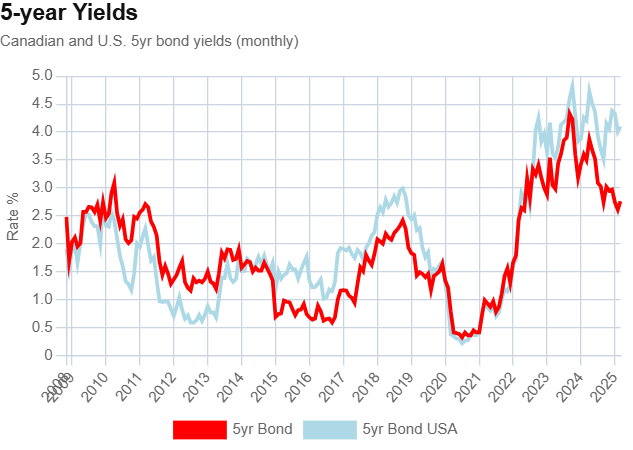
Fixed mortgage rates are tied to bond yields rather than the central bank’s policy rate. However, these yields are highly sensitive to U.S. economic data and trade tensions. A spike in short-term bond yields following a trade deal would almost certainly lead to more expensive fixed-rate mortgage products.
You would get heat from both directions. Inflation from economic growth because of the deal, and inflation coming from high oil prices.
Benjamin Tal, CIBC deputy chief economist
Options for Mortgage Holders
Homeowners currently navigating the market have several options to protect themselves against potential rate volatility. Understanding the difference between product types is vital when interest rate hikes are on the horizon.
Variable rate mortgages are the most sensitive to central bank decisions. If you hold a variable rate, you should prepare for the possibility of higher monthly payments if the Bank of Canada acts to curb inflation following a trade deal.
Fixed rate mortgages offer protection against immediate rate changes. By locking in a rate, you insulate your monthly budget from the volatility caused by bond market fluctuations, though you may pay a premium for this certainty.
Refinancing is another option for those currently in high-interest products. If you are concerned about future rate hikes, consulting a mortgage broker can help you determine if locking into a fixed term now is more cost-effective than waiting for the market to shift.
- Consider a fixed-rate mortgage to lock in current costs before potential trade-related rate increases.
- Evaluate your cash flow to ensure you can absorb higher payments if you currently hold a variable-rate mortgage.
- Consult a mortgage broker to compare the long-term costs of different term lengths against your personal financial goals.
- Monitor bond yield trends, as these are leading indicators for fixed mortgage rate movements.
- Review your budget for potential interest rate hikes to avoid financial stress if borrowing costs rise.
Analyzing the Economic Trade-Off
Launch Len Media maintains that while a trade deal is essential for long-term economic stability, the immediate inflationary pressures associated with global conflicts could paradoxically lead to higher interest rates. The resolution of trade tensions removes a significant drag on the economy, which historically leads to tighter monetary policy.
A fair counterpoint is that resolving trade tensions would reduce economic uncertainty, potentially boosting consumer confidence and stabilizing the housing market. This stability could eventually lead to more favorable borrowing conditions as the economy finds a new, more predictable equilibrium.
Despite this, the current geopolitical climate, particularly the conflict in Iran, continues to exert upward pressure on oil prices. This external factor makes it difficult for the Bank of Canada to ignore inflationary signals, regardless of the progress made in trade negotiations.
Therefore, homeowners should remain cautious. Even if a trade deal is signed, the broader economic environment suggests that the era of ultra-low interest rates is likely behind us, and planning for higher costs is the most prudent path forward.
Next Steps for Homeowners
You should first assess your current mortgage contract to determine if you are in a variable or fixed-rate product. Knowing your sensitivity to central bank policy is the first step in managing your risk.
Next, speak with a financial advisor or mortgage broker to run scenarios based on potential rate increases. Seeing the impact on your monthly budget in dollar terms can help you make an informed decision about whether to lock in a rate.
Monitor official statements from the Bank of Canada and major economic reports regarding trade progress. These updates will provide the best clues regarding the timing and magnitude of future rate adjustments.
Finally, ensure your emergency fund is adequately stocked. Having a buffer of three to six months of living expenses can provide peace of mind if your mortgage payments increase as a result of shifting economic conditions.
Frequently Asked Questions
Will a trade deal definitely increase my mortgage rate?
Not necessarily, but it increases the likelihood of rate hikes by the Bank of Canada. A deal removes economic uncertainty, which often leads to higher inflation and subsequent increases in interest rates.
How do global conflicts affect my mortgage?
Global conflicts, such as the war in Iran, impact oil prices and global supply chains. These factors contribute to inflation, which forces the Bank of Canada to keep interest rates higher than they would be in a stable environment.
Should I switch to a fixed-rate mortgage now?
This depends on your risk tolerance and financial goals. A fixed-rate mortgage provides certainty, but you should compare the current fixed rates against your expectations for future rate changes before making a switch.
Related reading on Launch Len Media: Bank of Canada warns of energy price shock.
For official background, see Bank of Canada.