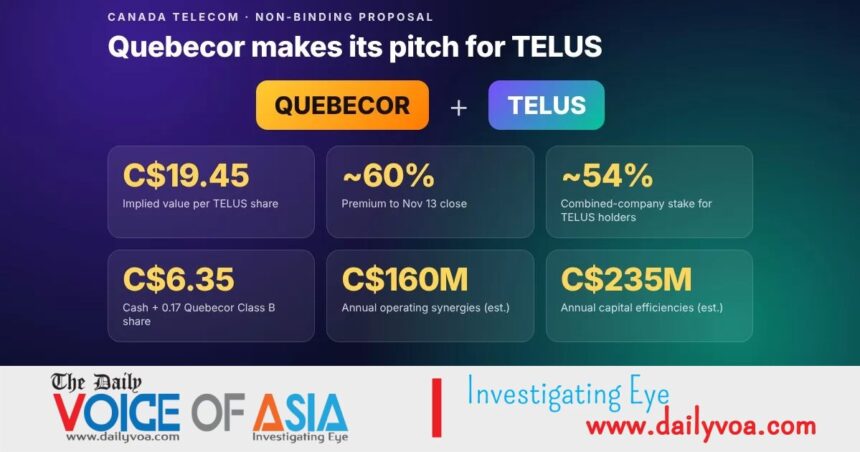
Quebecor has officially submitted a $31 billion unsolicited bid to acquire Telus, aiming to combine their respective telecommunications networks and spectrum assets. The proposal, announced November 16, 2026, represents a significant 60% premium over the closing share price of Telus on November 13.
This potential merger marks a critical juncture for the Canadian telecommunications landscape, balancing the promise of increased infrastructure investment against the threat of reduced market competition. Launch Len Media views this consolidation as a high-stakes gamble that prioritizes national digital sovereignty at the potential expense of consumer affordability.
The Terms of the $31 Billion Proposal
The proposed transaction is a cash-and-stock deal that would see Telus shareholders receive $6.35 in cash and 0.17 Quebecor Class B shares for every Telus share held. Based on the November 13, 2026, closing price of $12.14 for Telus, the offer values the company at $19.45 per share. Source: Beinsure.
Quebecor, acting as the acquirer, has disclosed that this is an unsolicited, non-binding proposal. The company had previously submitted an initial non-binding offer on June 26, followed by a revised version on November 9 before the public disclosure on November 16.
The bidder argues that the combination of networks and spectrum holdings would create a more robust national competitor. Quebecor estimates the merger would generate $395 million in annual operating and capital efficiencies, which it claims would support faster 5G deployment.
Industry Minister Mélanie Joly has confirmed that the federal government will subject the proposal to a rigorous review process. Both the Competition Bureau and the CRTC are expected to examine the implications for market concentration and service quality.

Regulatory Hurdles and Strategic Risks
Telus has responded to the proposal by forming a special committee of independent directors to evaluate the offer. John Manley, chair of the Telus board, stated that the committee is working with external advisers to assess the financial and strategic implications of the bid.
The board has expressed significant caution regarding the regulatory environment. More than four months after the initial approach, Telus leadership noted that Quebecor has failed to explain how the deal could clear the current Canadian regulatory framework.
The central concern for regulators is the reduction of the national wireless market from four major players to three. Historically, Canadian regulators have prioritized maintaining four distinct providers to ensure competitive pricing and service availability for consumers.
Telus warned that the regulatory proceedings could be both lengthy and expensive. The company indicated that these costs could impose a substantial burden on shareholders while the outcome of the merger remains uncertain.
To date, this review has surfaced a number of significant risks associated with Quebecor’s proposal, including the fact that more than four months after its initial proposal, Quebecor has yet to explain how what it is proposing could be approved under the current telecom regulatory framework in Canada.
John Manley, chair of the Telus board
Evaluating the Strategic Rationale
Quebecor frames the merger as a necessary step to protect Canada’s digital sovereignty. The company argues that a larger, unified operator is required to stand up to foreign satellite and technology competitors that are increasingly entering the Canadian market.
By pooling resources, the combined entity would theoretically have greater investment capacity for rural and underserved areas. Quebecor maintains that this scale is essential for competing on equal terms with other national providers.
However, market analysts remain skeptical of these claims. They point out that consolidation often leads to higher prices for end users when competitive pressure is removed from the marketplace.
The market reaction to the bid has been mixed as investors weigh the 60% premium against the high probability of regulatory rejection. Shareholders are currently awaiting further updates from the special committee regarding potential alternatives.
- Consolidation of wireless networks and spectrum assets.
- Projected annual efficiencies of $395 million.
- Increased capacity for 5G infrastructure deployment.
- Strengthened defense against foreign tech competition.
- Potential for reduced consumer choice and higher prices.
Analysis of the Competitive Landscape
The argument for national sovereignty is a compelling narrative, yet it often masks the practical reality of market concentration. Reducing the number of major providers from four to three creates a clear risk of an oligopolistic environment where price competition diminishes.
While Quebecor promises efficiencies, these savings are rarely passed on to the consumer in a market with limited competition. The history of Canadian telecommunications suggests that regulators are highly sensitive to price hikes following industry consolidation.
The counterpoint is that Canada needs a champion capable of competing with global tech giants. If domestic players are too small, they may fail to innovate or maintain infrastructure at the pace required by modern digital demands.
Ultimately, the deal hinges on whether the government believes that national scale outweighs the benefits of a four-player market. Given the political sensitivity of telecom pricing, the bar for approval is exceptionally high.
Next Steps for Shareholders and Consumers
Investors should monitor the special committee’s findings closely, as they will likely outline whether Telus intends to pursue other strategic alternatives. The current premium is contingent on a successful merger, which remains far from guaranteed.
Consumers should prepare for a prolonged period of uncertainty. Regulatory reviews of this magnitude often span many months, during which time service pricing and investment strategies may remain in flux.
Those interested in the broader implications of this deal should track developments regarding the Competition Bureau’s assessment. Any signal from the regulator regarding the competitive impact will likely dictate the future of the proposal.
For those tracking the company, understanding the telus strategic pivot is essential to gauging how the board views its long-term viability outside of this merger. Keep an eye on official company filings for updates on the special committee’s progress.
Frequently Asked Questions
Is the Quebecor offer for Telus a done deal?
No. The proposal is non-binding and has not been accepted by the Telus board. It remains subject to extensive regulatory review and potential rejection.
Why is the Canadian government involved in this merger?
The Competition Bureau and the CRTC must review the deal to ensure it does not violate competition laws or harm consumer interests. The Industry Minister has confirmed that the review will be rigorous.
What happens to Telus shareholders if the deal goes through?
Shareholders would receive $6.35 in cash and 0.17 Quebecor Class B shares for each Telus share they own. This structure is intended to provide a 60% premium over the November 13, 2026, closing price.
Related reading: Telus Health impairment, Competition Bureau.