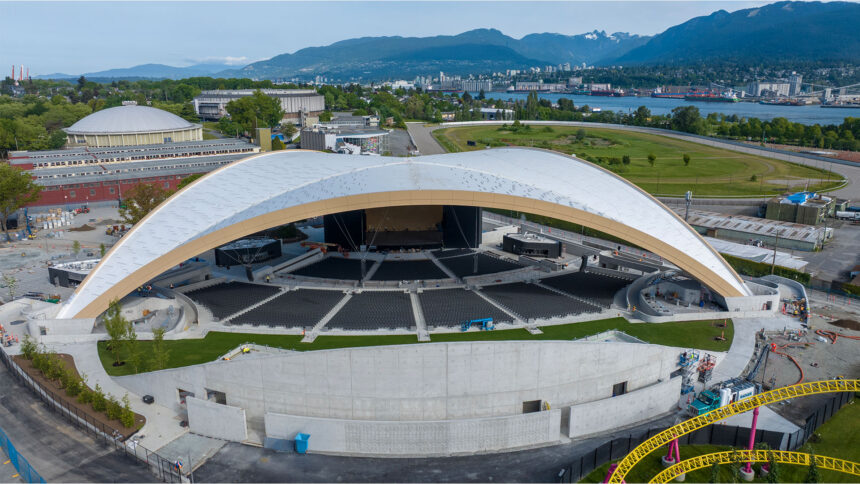
The Freedom Mobile Arch officially opened in Vancouver’s Hastings Park in 2026, serving as a 10,000-seat outdoor performance venue. The structure features a 105-meter free-span mass timber roof, marking a significant achievement in modern civic engineering.
This facility represents a complex intersection of corporate branding and public infrastructure. Launch Len Media views this project as a successful, albeit controversial, model for financing sustainable public assembly spaces through private-sector partnerships.
Engineering the Timber Arch
The Freedom Mobile Arch replaces a 1960s-era amphitheatre that had long been considered an underutilized asphalt patch. According to the Pacific National Exhibition, the new venue was completed in June 2026 to meet the demands of a growing city. Source: Canadian Architect.
The roof structure is a feat of equilateral-triangle geometry designed by Revery Architecture. Structural engineering firm Fast + Epp reported that the roof consists of 60 glulam arches arranged in six intersecting barrel-vaulted segments.
These segments meet at a central keystone before transferring loads to concrete buttresses. The entire span measures 105 meters from tip to tip, making it one of the largest free-span timber arch roofs in the world.
Engineers faced unique challenges due to the open-air nature of the design. Because the structure lacks a traditional building envelope, the team conducted wind tunnel and snow-drift studies to ensure stability under various weather conditions.
The construction process utilized black spruce glulam sourced from northern Quebec. Fabricators Nordic Structures and Walters Group managed the precision requirements, holding tolerances to two millimeters for the steel armatures.
Sustainability and Civic Integration
The project was designed to align with stringent environmental targets. According to Stantec, the venue aims to achieve LEED Gold certification and meets the Zero Carbon Building standard.
Sustainability features include an integrated rainwater capture system within the buttress geometry. The design also incorporates a ramp-and-stair network that adheres to Rick Hansen Gold accessibility standards.
The aesthetic goal was for the architecture to recede into the landscape. Architect Venelin Kokalov stated that the priority was to ensure the structure did not distract from the performer or the mountain views.
Public art is woven into the fabric of the facility to honor local heritage. The Musqueam, Squamish, and Tsleil-Waututh Nations collaborated on three permanent commissions, including glasswork and sandblasted concrete walkways.
The venue’s acoustic performance was a primary driver of the timber roof design. The dense mass-timber material helps reflect sound back toward the audience while a rear concrete wall provides noise mitigation for the surrounding community.
Options for Public Venue Funding
The Freedom Mobile Arch serves as a case study for municipal funding models. Cities looking to replicate this success have several options for balancing public needs with private investment.
Corporate Naming Rights: This approach, used for the Freedom Mobile Arch, allows private firms to gain brand visibility in exchange for capital contributions. It is effective for high-profile venues but requires careful management of public perception.
Public-Private Partnerships (P3): These agreements distribute risk between government entities and private developers. They are often used for large-scale infrastructure but can lead to long-term contractual obligations for the municipality.
Community Benefit Agreements: These ensure that projects provide tangible value to local residents, such as the Indigenous art installations seen in this project. They can mitigate criticism regarding the commercialization of public spaces.
Green Bond Financing: Municipalities can issue bonds specifically for projects meeting LEED or Zero Carbon standards. This attracts environmentally conscious investors and lowers the cost of borrowing for sustainable developments.
- Corporate Naming Rights
- Public-Private Partnerships
- Community Benefit Agreements
- Green Bond Financing
Analysis of the Corporate Branding Model
The Freedom Mobile Arch represents a successful fusion of corporate branding and sustainable civic infrastructure. By securing private funding, the City of Vancouver was able to deliver a world-class facility that might have otherwise faced significant budget delays.
Critics argue that naming a prominent public landmark after a private telecommunications company risks the commercialization of civic spaces. There is a valid concern that such branding can erode the sense of public ownership over heritage sites.
However, the project’s architectural quality and commitment to sustainability provide a strong counter-argument. The venue serves as a functional, high-performance space that benefits the public regardless of its corporate name.
The success of this project suggests that as long as the design remains high-quality and inclusive, the public is often willing to accept corporate branding in exchange for better amenities. The Freedom Mobile name is likely to become a standard identifier for the venue over time. For the carrier, the arch is a high-visibility marketing play that sits alongside its push for subscribers, covered in our look at the Freedom Mobile winback strategy.
As architects, we have a responsibility to create meaningful spaces that go beyond form and function.
Venelin Kokalov, principal at Revery Architecture
Next Steps for Urban Planners
If you are involved in municipal planning, consider the following steps to evaluate similar projects. First, assess the long-term maintenance costs associated with mass timber structures in your specific climate.
Second, engage with local Indigenous nations early in the design process. The integration of cultural heritage in the Freedom Mobile Arch was a key factor in its community acceptance.
Third, conduct thorough wind and seismic testing for any open-air designs. The engineering precision required for this project highlights the necessity of expert consultants when dealing with unique geometries.
Finally, establish clear guidelines for corporate naming rights before seeking partners. Ensuring that branding does not overshadow the public purpose of the space is essential for maintaining community trust.
Frequently Asked Questions
What is the primary material used for the roof?
The roof is constructed from mass timber, specifically black spruce glulam sourced from northern Quebec.
How many people can the Freedom Mobile Arch accommodate?
The venue has a capacity of 10,000 seats for outdoor performances.
Was the project completed on time for its intended use?
Yes, the project was fast-tracked to meet the deadline for the 2026 FIFA Fan Festival held in Vancouver.