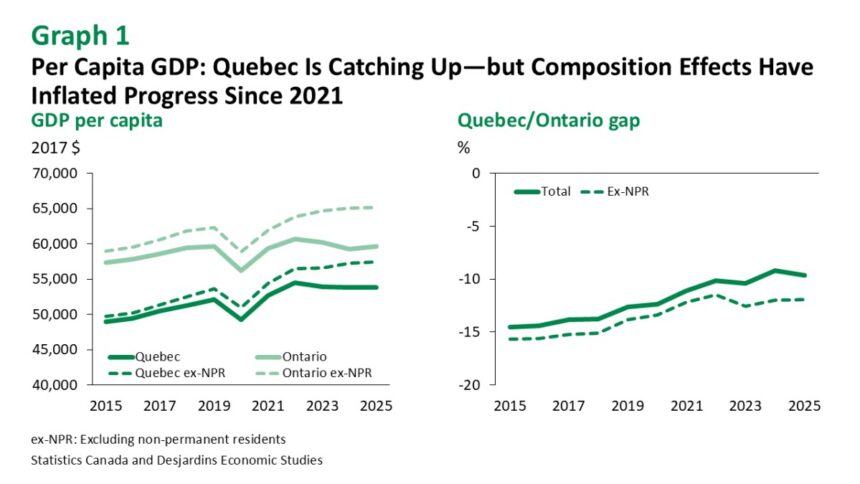
Quebec’s regions have nearly eliminated the GDP gap with their Ontario counterparts, according to a November 2026 report from the Institut du Québec.
While regional economies show significant convergence, Montreal continues to trail Toronto, highlighting a persistent economic divide between the two provinces’ largest metropolitan hubs.
This divergence suggests that while decentralized development is succeeding in smaller communities, the province faces structural hurdles in competing with Toronto’s specialized service-based economy.
Regional Convergence and Metro Stagnation
The Institut du Québec report provides a detailed look at how economic output has shifted across provincial borders over the last decade. Researchers measured the GDP gap using output per capita, which tracks the productivity of residents rather than total household wealth. Source: Wealth Professional.
Data indicates that Quebec regions outside of Montreal have successfully closed the distance to Ontario’s non-metropolitan areas. In 2011, Quebec’s regional GDP per capita stood at 91 percent of Ontario’s equivalent, but by 2022, that figure rose to 99 percent.
In contrast, the economic relationship between Montreal and Toronto remains static. Montreal’s GDP per capita has stayed at approximately 80 percent of Toronto’s level for years.
Jean-Baptiste Vallantin-Dulac, an economist at the Institut du Québec, noted that the catch-up has been driven primarily by regional performance. He stated that Montreal’s failure to close the gap is not necessarily due to poor performance, but rather the unique economic structure of its neighbor.
The two have complementary economies, and a high-performing metropolis helps the whole province.
Emna Braham, President and CEO of the Institut du Québec

The Finance Sector Advantage
A primary driver of Toronto’s economic lead is its concentration in the finance and insurance sectors. These industries generate significant GDP per capita and attract high-income professionals to the city.
Montreal lacks a comparable density of these high-value service roles, which limits its ability to match Toronto’s economic output. The report highlights that this sectoral imbalance is a key factor in the persistent GDP gap between the two cities.
Beyond industry composition, workforce demographics play a critical role in the disparity. Montreal’s working-age population is projected to return to 2011 levels by 2030, while Toronto’s is expected to remain 20 percent larger than it was in 2011.
Educational attainment also favors the Ontario hub. Approximately 52 percent of working-age Torontonians hold a university degree, compared to 43 percent of working-age Montrealers.
Strategic Options for Economic Growth
To address the widening potential for a metro gap, the report suggests several strategic shifts for Quebec policymakers. These options focus on talent retention and regional integration.
1. Immigration Reform: The province must refine its immigration policies to specifically target highly skilled workers. Without this, the gap between Montreal and Toronto is expected to widen as the working-age population shrinks.
2. Regional Development: Policymakers should continue to support the economic success seen in Quebec’s regions. These areas have proven that provincial prosperity does not require a reliance on a single metropolitan hub.
3. Housing Affordability: While Montreal remains more affordable than many North American cities, rising costs are beginning to deter residents from other regions. Ensuring housing remains accessible is vital for attracting and keeping talent.
4. Training Initiatives: Expanding training opportunities in the regions can help maintain the momentum of recent years. By aligning skills with current job market demands, the province can ensure that regional growth is sustainable.
Analysis of Provincial Competitiveness
LaunchLen’s view is that Quebec’s regional success demonstrates the effectiveness of decentralized development and diversification. By fostering growth outside of the main metropolitan hub, the province has proven that prosperity is not solely dependent on a single urban center.
However, a fair counterpoint is that the persistent GDP gap between Montreal and Toronto highlights a critical structural weakness. Quebec’s struggle to compete in high-value service sectors like finance could threaten long-term provincial competitiveness.
This structural issue suggests that while regional growth is a positive development, it cannot fully replace the need for a high-performing metropolis. If Montreal continues to lose residents to other regions and fails to attract top-tier talent, the province may face long-term economic stagnation.
The goal should be a balanced approach where regional success supports the metropolis, rather than one coming at the expense of the other. Targeted immigration and talent retention policies are the most likely levers to correct this imbalance.
Next Steps for Stakeholders
Advisors and business leaders should monitor these trends closely when planning for future investments. Understanding the shift in regional output can help in identifying new growth opportunities outside of traditional hubs.
For those operating in Montreal, the focus should be on workforce development and addressing the skills gap. Investing in local training programs may help mitigate the impact of a shrinking working-age population.
Business owners should also consider the implications of housing costs on their ability to attract talent. As the cost of living in Montreal rises, firms may need to offer more competitive packages or consider remote work arrangements to retain staff.
Finally, stakeholders should engage with provincial policy discussions regarding immigration. Supporting policies that prioritize high-skilled labor will be essential for maintaining the province’s competitive edge in the coming years.
Frequently Asked Questions
Why is Montreal’s GDP per capita lower than Toronto’s?
The gap is largely attributed to Toronto’s heavy concentration in the lucrative finance and insurance sectors, which drive higher economic output per capita.
Are Quebec’s regions performing better than Ontario’s regions?
Quebec’s regions have shown significant progress, reaching 99 percent of Ontario’s regional GDP per capita by 2022, effectively closing the gap that existed in 2011.
What is the primary risk identified in the report?
The report warns that the gap between Montreal and Toronto may widen if Quebec fails to attract a highly skilled workforce through improved immigration policies.