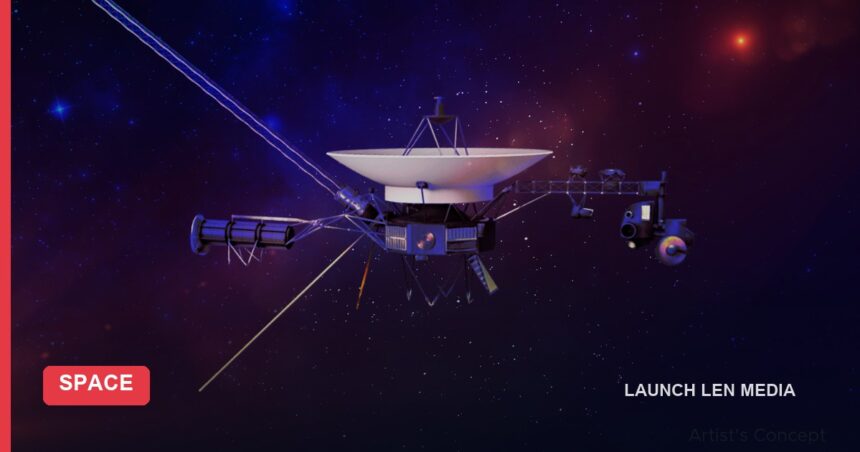
Voyager 1 will become the first human-made object to sit one light-day from Earth on Wednesday, Nov. 18, 2026. At that distance, about 25.9 billion kilometres, a radio message travelling at the speed of light needs 24 hours to reach the spacecraft. Source: NASA.
- What Happens on November 18
- Why a Two-Day Conversation Matters
- A Tough Autumn: Power Swaps and a Lost Signal
- How Much of Voyager 1 Still Works
- Voyager 1 vs. Voyager 2
- Our Analysis: The Delay Keeps Growing
- A Fair Counterpoint
- How Canadians Can Follow the Milestone
- What Comes Next for the Voyagers
- Frequently Asked Questions
- Sources and Further Reading
The probe launched on Sept. 5, 1977, and EarthSky calculates it has taken 49 years, 2 months and 11 days to cover that gap. Source: EarthSky.
The crossing is a symbolic marker rather than a science discovery, but it lands at a tense moment for the mission. Engineers spent the fall saving power and recovering from a two-day loss of contact, and the team now plans every command around a two-day wait.
What Happens on November 18
NASA’s Voyager tracking page lists the moment as 2:16:07 a.m. Pacific Standard Time on Nov. 18. At that point the agency expects Voyager 1 to be about 16.094 billion miles (25.902 billion km) from Earth. Source: NASA Science.
For readers in Canada and the eastern US, that converts to 5:16 a.m. Eastern and 6:16 a.m. Atlantic time. EarthSky gives the same moment as 10:16:07 UTC. Source: EarthSky.
25.9B km
Distance on Nov. 18
24 hrs
One-way signal time
61,155 km/h
Cruising speed
49 yrs
Since 1977 launch
A light-day is the distance light covers in 24 hours. EarthSky puts it at roughly 173 astronomical units, meaning 173 times the average distance between Earth and the Sun. Source: EarthSky.
The gap has been closing for weeks. In early October, EarthSky reported Voyager 1 was about 15.98 billion miles (25.72 billion km) away, with light taking 23 hours, 52 minutes and 30 seconds to reach Earth. Source: EarthSky.
Nothing physical changes on board when the line is crossed. The spacecraft keeps coasting on the same path, and the importance is in what the distance means for the people who still fly it from California.

Why a Two-Day Conversation Matters
Voyager is controlled through NASA’s Deep Space Network, a set of large radio antennas at three sites around the world managed by NASA’s Jet Propulsion Laboratory (JPL). Once the probe sits a light-day away, every command and reply needs about 48 hours to make the round trip. Source: NASA JPL.
Project manager Suzanne Dodd summed up the new routine in JPL’s Oct. 29 update. She said a team member sends a message, then has to go home and wait two days for the answer. Source: NASA JPL.
The link is also slow. CNN reported in December 2025 that Voyager 1 returns data at about 160 bits per second, a rate it compared to dial-up internet. Source: CNN via CP24.
That delay shapes how the team works. Engineers cannot watch a fix in real time; they send commands and then wait to learn how the spacecraft responded. For example, a command sent at 9 a.m. Eastern on Nov. 18 would reach Voyager 1 at about 9 a.m. the next day, and the earliest reply would land around 9 a.m. on Nov. 20. JPL says the probe’s own fault-protection software takes over when something goes wrong in the meantime.
You send your message and then you go home and you wait two days.
Suzanne Dodd, Voyager project manager, NASA JPL
A Tough Autumn: Power Swaps and a Lost Signal
In early September, engineers switched off three devices on Voyager 1 and turned on three lower-power replacements at the same moment. JPL said all six devices help keep the spacecraft warm, so the swap had to cut power use without leaving parts too cold. Source: NASA JPL.
The team ran the same procedure on Voyager 2 about six weeks earlier. JPL said that without the change, another science instrument would likely have been turned off as early as summer 2027. Source: NASA JPL.
Then on Oct. 18 and 19, the Deep Space Network failed to hear Voyager 1 during two scheduled checks 24 hours apart. The signal came back on Oct. 20, and the team found that one set of thrusters had gone offline and the spacecraft had switched itself to backups. Source: NASA JPL.
JPL said the cause was still under investigation. Mission manager Kareem Badaruddin said it was the first time the team had seen the spacecraft behave that way, adding that the mission has reached a point where it must expect the unexpected. Source: NASA JPL.
- Early September 2026: three-for-three device swap on Voyager 1, about six weeks after Voyager 2.
- Oct. 18 to 19: no signal detected on two scheduled attempts.
- Oct. 20: signal returns; backup thrusters found active.
- Nov. 18: one light-day from Earth.
How Much of Voyager 1 Still Works
Voyager 1 launched with 10 science instruments, according to JPL. Some were turned off after the planet flybys ended, and two have been shut down in recent years to save power. Source: NASA JPL.
NASA’s status table shows only the magnetometer and the plasma wave instrument still running on Voyager 1. The cosmic ray instrument went off on Feb. 25, 2025, and the low-energy charged particle instrument followed on April 17, 2026. Source: NASA Science.
EarthSky noted that the low-energy charged particle instrument had been measuring electrons, ions and cosmic rays in interstellar space before it was shut off. The outlet reported that NASA could turn it back on later. Source: EarthSky.
Both probes run on radioisotope thermoelectric generators, which turn heat from decaying plutonium into electricity. JPL says each one loses about 4 watts of power every year, which is why the team keeps trading equipment for time. Source: NASA JPL.
CNN reported that the team treats the magnetometer and plasma wave instruments as top priorities on both spacecraft. Together they let the probes report on conditions in interstellar space, which CNN compared to a weather station. Source: CNN via CP24.
| Instrument | Voyager 1 | Voyager 2 |
|---|---|---|
| Magnetometer | On | On |
| Plasma Wave Subsystem | On | On |
| Cosmic Ray Subsystem | Off (Feb. 2025) | On |
| Low-Energy Charged Particles | Off (April 2026) | Off (March 2025) |
| Plasma Science | Off (2007, degraded) | Off (Sept. 2024) |
| Cameras (Imaging Science) | Off (1990) | Off (1989) |
Voyager 1 vs. Voyager 2
The twin probes were built to use a lineup of the outer planets that happens once every 176 years, NASA says. Voyager 1 entered interstellar space in 2012 and Voyager 2 followed in 2018. Source: NASA.
Voyager 2 actually launched a few weeks earlier and took the longer Grand Tour past Jupiter, Saturn, Uranus and Neptune. Voyager 1 visited only Jupiter and Saturn before heading out faster. Source: EarthSky.
EarthSky says Voyager 2 is about 2 billion miles (3.2 billion km) closer to Earth and moving a little slower. It is not expected to reach one light-day until November 2035. Source: EarthSky.
Both probes will keep drifting long after they fall silent. EarthSky says Voyager 2 will pass within about 1.7 light-years of the star Ross 248 in roughly 40,000 years. Source: EarthSky.
Voyager 1 has held a speed of about 38,000 mph on the same path since its Saturn flyby in November 1980, CNN reported. At that pace it covers roughly 1.5 million kilometres a day. Source: CNN via CP24.
| Voyager 1 | Voyager 2 | |
|---|---|---|
| Planets visited | Jupiter, Saturn | Jupiter, Saturn, Uranus, Neptune |
| Entered interstellar space | 2012 | 2018 |
| One light-day from Earth | Nov. 18, 2026 | Expected Nov. 2035 |
| Science instruments on | 2 | 3 |
Our Analysis: The Delay Keeps Growing
Launch Len Media worked through NASA’s own figures to show how quickly the gap widens. At JPL’s stated cruising speed of 61,155 km/h, Voyager 1 moves about 1.47 million kilometres farther out every day. Source: NASA JPL.
Light travels about 299,792 kilometres per second, so each day’s travel adds roughly 4.9 seconds to the one-way signal time. Over a year that is close to 30 more minutes, before accounting for Earth’s own orbit, which makes the real distance swing up and down through the year.
Earth’s orbit matters more than it sounds. EarthSky’s early-October light time of 23 hours, 52 minutes and 30 seconds is about 7.5 minutes short of the 24-hour mark NASA expects on Nov. 18. That is a faster climb than Voyager’s speed alone explains, because Earth’s position around the Sun is also changing the distance. The long-term direction does not change: the round trip only gets longer. Source: EarthSky.
A Fair Counterpoint
A fair counterpoint is that a light-day is a round number chosen by people, not a boundary in space. The scientific milestones came earlier, when each probe crossed into interstellar space in 2012 and 2018. Source: NASA.
The data stream is also thinning. With two instruments left on Voyager 1, a power budget that falls every year, and an unexplained thruster switch in October, the mission’s remaining science is far narrower than the 10-instrument package it launched with. Source: NASA Science.
Still, the team is working to stretch what remains. Dodd told CNN in December 2025 that she believed at least one probe could keep operating for another two to five years. Source: CNN via CP24.
How Canadians Can Follow the Milestone
NASA is inviting people worldwide to take part in “Shine Bright for Voyager’s Light-Day” after sunset on Tuesday, Nov. 17. A NASA web page will let a phone or tablet flash “VGR,” Voyager’s call sign, in Morse code, and the agency is asking participants to share photos or video tagged @NASA. Source: NASA.
On Thursday, Nov. 19, at 12 p.m. Eastern (9 a.m. Pacific), JPL will host a moderated discussion in its von Kármán Auditorium, streamed on NASA Live. Speakers include Nicky Fox, who leads NASA’s Science Mission Directorate,, JPL chief scientist Jonathan Lunine, Dodd, Badaruddin and deputy project scientist Jamie Rankin of Princeton University. Source: NASA.
The event will also preview a NASA+ documentary planned for 2027, the mission’s 50th anniversary year. CNN reported the team’s goal is to keep both probes running to that anniversary. Source: CNN via CP24.
- Nov. 17, after sunset: flash “VGR” from your phone through NASA’s event page.
- Nov. 18, 5:16 a.m. Eastern: the one-light-day crossing.
- Nov. 19, noon Eastern: live JPL panel on NASA Live (nasa.gov/live).
- Any time: check NASA’s “Where Are Voyager 1 and Voyager 2 Now?” page for live distance figures.
What Comes Next for the Voyagers
The near-term goal is the 50th anniversary in 2027. JPL’s September power swap was designed to keep Voyager 1’s remaining instruments running past the point where one might otherwise have been switched off in summer 2027. Source: NASA JPL.
Further cuts are likely as power drops, and NASA has not published a date for ending either mission. The agency’s Heliophysics Division funds the work, and the spacecraft are built and operated by JPL, which is managed by Caltech. Source: NASA.
For more on how NASA manages ageing spacecraft, see our coverage of the Swift observatory’s re-entry after a failed rescue. Our report on the 2026 ozone hole and the Montreal Protocol covers another long-running NASA science record.
Frequently Asked Questions
What does one light-day from Earth mean?
It is the distance light travels in 24 hours, about 25.9 billion kilometres. A radio signal sent to Voyager 1 on Nov. 18 will take a full day to arrive, and a reply takes another day to come back.
What time does Voyager 1 reach one light-day in Canada?
NASA lists 2:16:07 a.m. Pacific on Nov. 18, 2026. That is 5:16 a.m. Eastern, 6:16 a.m. Atlantic and 3:16 a.m. Mountain time.
Is Voyager 1 still sending data?
Yes. NASA’s status page shows its magnetometer and plasma wave instrument still operating, and CNN reported a data rate of about 160 bits per second. Contact was briefly lost on Oct. 18 and 19 but returned on Oct. 20.
When will Voyager 2 reach one light-day?
EarthSky says Voyager 2 is expected to reach the same distance in November 2035. It is about 3.2 billion kilometres closer to Earth and travels slightly slower than Voyager 1.
How long will the Voyager probes keep working?
NASA has not set an end date. The team aims to reach the 50th anniversary in 2027, and Dodd told CNN in December 2025 that at least one probe might operate for two to five more years.
Sources and Further Reading
- NASA: Voyager 1 one-light-day activities (Nov. 10, 2026)
- NASA JPL: Voyager 1 conserves power, resolves communications pause (Oct. 29, 2026)
- NASA Science: Where are Voyager 1 and Voyager 2 now?
- EarthSky: Voyager 1 reaches 1 light-day from Earth (Nov. 10, 2026)
- CNN via CP24: Voyager 1 will reach one light-day from Earth in 2026 (Dec. 9, 2025)
This article was researched with AI assistance and checked against the sources listed above. Facts are current as of the publication date; follow the source links for updates.