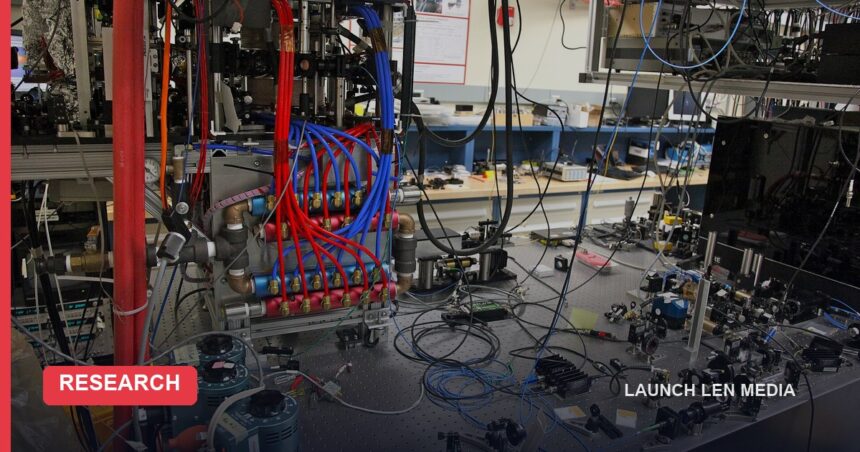
Physicists have made a supersolid at room temperature using particles that are part light and part matter. A supersolid is a state of matter that holds a crystal-like pattern while it also flows with no friction, and the first ones, made from atoms, needed cooling close to absolute zero.
The team behind the result spans the University of Warsaw, Poland’s Military University of Technology, IBM Research Zurich, France’s CNRS and other labs, with 21 authors in all. Their small device can be tuned with a voltage, and the team says it can run at up to about 60°C. Source: University of Warsaw.
Here is what they built, why it matters, where the limits are, and what it could mean for quantum research in Canada and the U.S.
What the Researchers Reported
The study appeared in the journal Science Advances on Oct. 16. The University of Warsaw shared it with the press on Nov. 3, and a ScienceAlert report spread it widely this week. Source: EurekAlert!.
The key sign is a set of evenly spaced bright stripes in the light coming out of the device. They show the particles have formed a repeating, crystal-like pattern while still acting as one quantum fluid. Source: University of Warsaw.
The team also saw a regular pattern in how the light was polarized, called a spin helix. The university says this is the first supersolid platform of its kind that can be tuned with electricity. That claim comes from the authors and has not yet been checked by other groups. Source: University of Warsaw.
The work took years. A draft of the study first went online in July 2024 and was updated in December 2025, before the reviewed paper came out. Source: arXiv.
This is a textbook example of spontaneous symmetry breaking.
Guillaume Malpuech, Institut Pascal, CNRS (University of Warsaw release)

What a Supersolid Is, in Plain Terms
Most matter picks a side. A solid holds a fixed shape. A superfluid is a fluid that flows with no friction at all. A supersolid does both at once.
Physicists first predicted this in the 1960s. It took more than 50 years to see one, and the first ones were made in 2017 from very cold atoms. Source: EurekAlert!.
One of those 2017 tests, at MIT, cooled sodium atoms to a few billionths of a degree above absolute zero. The atoms formed a ripple pattern that MIT called a “stripe phase.” Source: MIT News.
MIT was not alone. A group in Switzerland reported a second way to turn a cold atom cloud into a supersolid, using mirrors to collect laser light scattered by the atoms. Source: MIT News.
Team leader Wolfgang Ketterle shared the 2001 Nobel Prize in physics for his work on these cold atom clouds. He called a material that is both solid and superfluid “counterintuitive.” Source: MIT News.
A Bose-Einstein condensate is a state where a huge number of particles share one quantum state and act as one. With normal atoms, that takes deep cooling, vacuum chambers and laser traps. That is why a room-temperature version is such a big deal.
How the Warsaw Device Works
The team did not use atoms. It used exciton-polaritons, which are particles that form when trapped light locks onto energy in a material. Each one is part light and part matter.
The device is a tiny gap, about 1.5 to 2 micrometres wide, between two mirrors. Inside sits a liquid crystal, like the kind in a screen, and two thin layers of a plastic-like material called MeLPPP. Source: arXiv.
The liquid crystal is the clever part. It splits the system into two equal low-energy states, and the particles fill both. The two parts overlap and make the stripes. Since the liquid crystal reacts to voltage, the team can tune it by changing the voltage. Source: arXiv.
Why does this work at room temperature? The light and matter in this device are bound tightly, at about 93 milli-electronvolts. That is far more than the heat energy at room temperature, about 25 milli-electronvolts, so heat does not break them apart. The 25 figure is a standard physics value, not one from the paper. Source: arXiv.
Short laser pulses feed in the energy. Each pulse lasts about 181 femtoseconds, and the spot it hits is about 20 micrometres wide. Source: arXiv.
The particles only pile into one state above a set power level. The bright, even part of the cloud is about 25 micrometres across. Source: arXiv.
- Mirrors: trap light in a tiny gap.
- Liquid crystal: splits the energy states and allows voltage tuning.
- MeLPPP layer: supplies the matter half of each particle.
- Laser pulses: feed in energy until the particles condense.
The Key Numbers
The figures below come from the University of Warsaw release and the draft version of the paper. The final paper’s numbers may differ slightly.
One key detail is how the stripes move. Each laser pulse put them in a new spot, so the system picked one of several equal options on its own. The draft reports a stripe contrast of 2.2% in averaged images, against about 0.7% if the spots were fully random. It also reports small whirlpools, or vortices, in about 10% of runs. Source: arXiv.
~60°C
Temperature the liquid-crystal microcavities can approach
Picoseconds
Lifetime of each exciton-polariton
1960s
When supersolids were first predicted
21
Authors on the Science Advances paper
That matters. Every real sample has tiny flaws that could pin the stripes in place. Stripes that shift from shot to shot, despite those flaws, point to a true quantum fluid, the authors argue. Source: arXiv.
Guillaume Malpuech of CNRS said theory predicted the supersolid could pick among several equal states, and that is what the team saw. Source: University of Warsaw.
| Experiment | What condensed | Temperature | Published |
|---|---|---|---|
| MIT (2017) | Sodium atoms with laser-induced spin-orbit coupling | Nanokelvin (near absolute zero) | Nature, March 2017 |
| CNR Nanotec, Italy (2025) | Exciton-polaritons in a photonic-crystal waveguide | Not stated in the CNR summary | Nature 639, March 2025 |
| Warsaw-led team (2026) | Exciton-polaritons in a liquid-crystal microcavity | Room temperature; device rated to approach 60°C | Science Advances 12, Oct. 2026 |
Why It Matters Beyond the Lab
Until now, supersolids lived in large, costly labs full of cooling gear. A version that works on a chip at room temperature could make this physics far easier to study. For example, a university lab without a cold atom setup could, in principle, explore the same effects with lasers and a microcavity.
Light-based supersolids are also new. In March 2025, a team at Italy’s CNR Nanotec reported in Nature a supersolid made from the same kind of light-matter particles, in a different device. Source: CNR Nanotec.
The Warsaw team lists very fast light-based chips, brain-like computing and optical sensors as areas that could gain. These are hopes the team describes, not working products. Source: University of Warsaw.
Thilo Stöferle of IBM Research said his group had worked with MeLPPP for years and had seen a condensate in it before. Pairing it with a liquid crystal, he said, was new. Source: University of Warsaw.
The Canada and U.S. Angle
There is a direct U.S. link. The lead author, Marcin Muszyński, now works as a postdoctoral researcher at The City College of New York. Source: University of Warsaw.
No Canadian lab is on the paper, but the field lines up with federal goals. Canada’s National Quantum Strategy has a quantum sensors mission, which aims to make Ottawa and key industries early users of quantum sensing. Source: ISED Canada.
In April 2026, NSERC announced close to $6 million for 90 quantum projects tied to those goals. It expects the work to train more than 125 grad students and postdocs. Source: NSERC.
For Canadian labs, a cheap, tunable, room-temperature setup could widen who gets to run these tests. Whether it does depends on other teams repeating the result.
A Fair Counterpoint
A fair counterpoint: “room temperature” does not mean ready for daily use. Each particle lasts only a few picoseconds, or trillionths of a second. The state exists only while the laser keeps feeding it. Source: University of Warsaw.
The samples are also fragile. The plastic-like layer slowly reacts with the liquid crystal, so tests had to finish within a few hours of building each device. Muszyński said repeating a test “meant fabricating an entirely new sample.” Source: University of Warsaw.
This is also a light-driven system, not the cold atom gases where supersolids were first shown. Other labs will need to repeat the work before it counts as a settled new platform.
There is also a sourcing caveat. Our methodology for this report: we read the University of Warsaw release, the free arXiv draft, the MIT and CNR Nanotec summaries, and the federal pages cited here. We could not open the final journal paper directly, so the detailed figures come from the draft and the release, and some can change slightly between versions.
What Comes Next and What Readers Can Do
The team says its next step is to use voltage control to study these supersolids in more depth and move toward light-based quantum devices. It gave no timeline. Source: University of Warsaw.
For most readers, this is a science story, not a product story. If you follow research news, our recent looks at a Nature study on smartwatch blood pressure alerts and the 2026 ozone hole show how to read new findings with care. Here is how to follow this one.
- Read the free draft on arXiv (2407.02406) for the methods, and the Science Advances paper for the reviewed version.
- Be wary of headlines saying quantum computers or sensors now “work at room temperature”; this is a physics result.
- Watch for other labs repeating it, for longer-lasting samples, and for more work on the vortices.
- Students and researchers in Canada can track NSERC quantum funding calls under the National Quantum Strategy.
Frequently Asked Questions
What is a supersolid?
A supersolid is a quantum state of matter that holds a regular, crystal-like structure while also flowing without friction like a superfluid. It was predicted in the 1960s and first observed in ultracold atoms in 2017.
Is this a room-temperature superconductor?
No. A supersolid is a different phenomenon from superconductivity. This experiment involves light-matter particles called exciton-polaritons, not electrical current flowing without resistance.
How hot can the device get?
The researchers say their liquid-crystal microcavities can operate at temperatures approaching 60°C. The supersolid itself was observed at room temperature.
Where was the study published?
The peer-reviewed paper appeared in Science Advances, volume 12, article eaee4875, on Oct. 16, 2026. An earlier preprint version is freely available on arXiv under the number 2407.02406.
Will this lead to quantum computers soon?
Not directly. The team describes ultrafast photonics, neuromorphic computing and optical sensing as possible future uses, but the particles last only picoseconds and the samples degrade within hours.
Were Canadian researchers involved?
No Canadian institution is listed on the paper. The first author is now at The City College of New York, and partners include institutions in Poland, Switzerland and France.
Sources and Further Reading
- University of Warsaw Faculty of Physics: A new quantum state of matter works at room temperature
- EurekAlert!: University of Warsaw news release (Nov. 3, 2026)
- Science Advances: Muszyński et al., eaee4875 (2026)
- arXiv:2407.02406, preprint of the study
- ScienceAlert: Physicists create an exotic quantum state of matter that works at room temperature
- MIT News: MIT researchers create new form of matter (2017)
- CNR Nanotec: Emerging supersolidity from a polariton condensate (2025)
- Innovation, Science and Economic Development Canada: National Quantum Strategy
- NSERC: Funding to support Canada's quantum ecosystem (April 2026)
This article was researched with AI assistance and checked against the sources listed above. Facts are current as of the publication date; follow the source links for updates.