As of October 26, 2026, the highest available 1-year GIC rates in Canada sit at approximately 4.00%, according to data from WOWA.ca. This follows a period of stability as the Bank of Canada maintained its policy interest rate at 2.25% throughout the year. Canadian dollar steadies after seven-day rally ahead of rate decisions
Locking in these rates now serves as a defensive hedge against economic volatility, providing investors with guaranteed returns in an uncertain climate. Launch Len suggests that securing current yields is a prudent move for those prioritizing capital preservation over speculative growth.
The current interest rate landscape
The Canadian financial sector is currently navigating a period of monetary policy stagnation. The Bank of Canada has held its policy interest rate at 2.25% throughout 2026, according to official bank filings updated in late October. Holding U.S. Stocks in a TFSA? What the Fine Print Means and the Canadian Alternatives I’d Buy
This policy hold has created a stable, albeit predictable, environment for fixed-income investors. Financial institutions have responded by adjusting their product offerings to remain competitive within this narrow band. Source: Bank of Canada.
Data from GICCalculator.ca shows that in October 2026, 18 out of 28 tracked issuers raised rates on at least one term. No financial institutions reported cuts during this same period, signaling a slight upward pressure on yields despite the policy hold.
Experts remain divided on the immediate future of these rates. According to reports from the Daily Hive, some analysts predict a 25-basis-point increase in the October 28 announcement, while others expect the central bank to maintain its current stance.

Mechanics of current GIC offerings
Understanding the structure of GIC offerings is essential for maximizing your return. Most competitive rates currently apply to non-redeemable, non-registered fixed-rate products. Expat’s TFSA Mistake Led to a Surprise CRA Penalty Tax
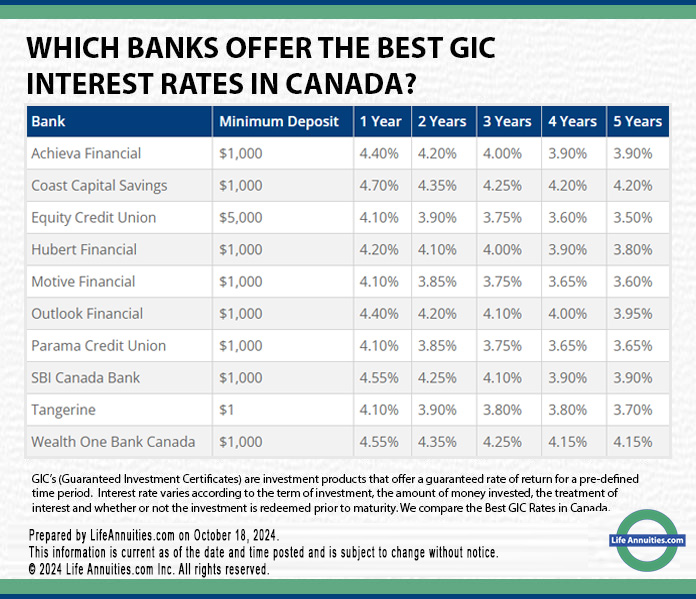
The 1-year term remains the most popular benchmark for retail investors. As of late October 2026, these products are yielding approximately 4.00% at the top end of the market.
Longer-term investments offer a premium for those willing to lock away capital for extended periods. Five-year GIC terms are currently reaching up to 4.55% at various Canadian financial institutions.
Investors should note that rates vary significantly by institution. A thorough comparison of both traditional banks and online-only lenders is necessary to capture the highest available yield.
Top GIC options for Canadian savers
Selecting the right GIC depends on your specific liquidity needs and investment horizon. The following options represent competitive choices based on current market data.
EQ Bank provides a 1-year non-registered GIC rate of 3.70% as of late October 2026. This option is frequently cited for its accessibility and digital-first platform, making it a strong contender for those who prefer online management. Source: WOWA.ca.
Other institutions are pushing 1-year rates toward the 4.00% mark. These products generally require a minimum deposit, often ranging from $1,000 to $5,000, depending on the specific bank’s policy.
For those seeking long-term growth, 5-year GICs at 4.55% offer a significant spread over shorter terms. These are ideal for investors who have a defined timeline for their capital and do not require access to the funds before maturity.
- 1-Year GICs: Currently yielding up to 4.00% for those seeking short-term stability.
- 5-Year GICs: Offering up to 4.55% for investors with longer time horizons.
- EQ Bank 1-Year GIC: A reliable digital option currently offering 3.70%.
- Non-registered accounts: Best for those who have exhausted their TFSA and RRSP contribution room.
Strategic analysis of the current market
Launch Len maintains that locking in current GIC rates is a prudent defensive strategy. With trade-related inflation risks and potential economic volatility on the horizon, a guaranteed return provides a necessary cushion for any balanced portfolio.
The fair counterpoint to this strategy involves the potential for future rate hikes. If the Bank of Canada chooses to increase the policy rate in the coming months, investors who wait could theoretically access higher yields on new GIC offerings.
However, the risk of waiting is that rates may remain flat or even decline if economic conditions weaken. By locking in a 4.00% or 4.55% rate today, you eliminate the uncertainty of future market movements.
This defensive approach prioritizes certainty over the slim possibility of marginal gains from future hikes. In an environment defined by policy ambiguity, guaranteed income remains a superior asset for risk-averse investors.
Even though GIC rates aren’t improving, there are still plenty of opportunities to earn at least 4% — so long as you’re comfortable locking your cash up for at least two years.
NerdWallet Canada
Next steps for your investment portfolio
You should first assess your liquidity requirements before purchasing any GIC. If you anticipate needing the funds for a home purchase or tuition within the next year, prioritize shorter terms even if the yield is slightly lower. Source: GICCalculator.ca.
Next, verify the deposit insurance coverage for your chosen institution. Ensure your investment falls within the CDIC limits or provincial credit union coverage to protect your principal investment.
Compare the tax implications of your account type. Holding GICs within a TFSA or RRSP can shield your interest income from immediate taxation, effectively increasing your net return compared to a non-registered account.
Finally, confirm the offer directly with the financial institution before finalizing your purchase. Rates can change rapidly, and promotional offers may have specific conditions regarding minimum deposits or account types.
Frequently Asked Questions
Are GIC rates expected to rise further in 2026?
Market analysts are divided on this issue. While some predict further rate hikes to combat inflation, others believe the Bank of Canada will maintain the current 2.25% policy rate due to economic uncertainty.
What is the difference between a redeemable and non-redeemable GIC?
Non-redeemable GICs typically offer higher interest rates but restrict your access to the funds until the maturity date. Redeemable GICs provide more flexibility to withdraw money early, usually at the cost of a lower interest rate.
How does the Bank of Canada policy rate affect my GIC returns?
GIC rates generally track the Bank of Canada’s policy interest rate. When the central bank raises rates, financial institutions typically increase the yields offered on new GIC products to remain competitive.