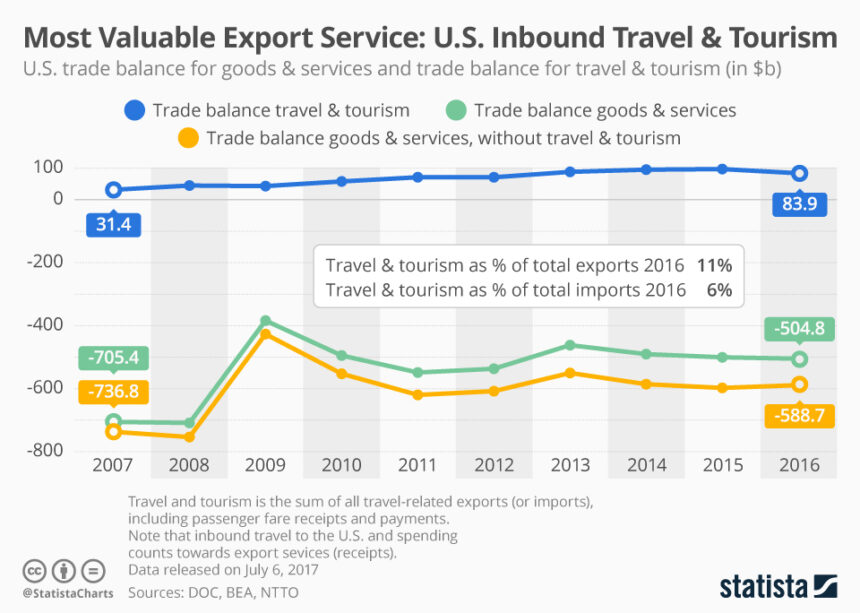
The United States travel sector recorded a nearly $14 billion trade deficit in 2025, representing the first such shortfall since data collection began in 1999. This historic reversal highlights a cooling trend in cross-border activity that has historically bolstered the American economy.
This shift matters because the U.S. tourism deficit signals a broader economic decoupling between the U.S. and its northern neighbor, threatening the stability of the hospitality labor market. Launch Len Media maintains that this decline is a direct consequence of protectionist trade policies and strained diplomatic relations that have discouraged traditional Canadian travel patterns.
The 2025 Travel Trade Reversal
The U.S. travel and tourism sector faced a significant downturn in 2025, resulting in a trade deficit of nearly $14 billion. This data, confirmed by the U.S. Joint Economic Committee, marks the first time the sector has failed to maintain a surplus since 1999. Source: Money.ca.
The decline was primarily driven by a sharp reduction in Canadian participation in the U.S. travel market. According to CBS News, Canadian visits to the United States fell by approximately 25% in 2025 compared to the previous year.
This drop in volume directly translated into lower revenue for American businesses. Statistics Canada reported that Canadian travel spending in the U.S. fell to $18.8 billion in 2025, down from $22.1 billion in 2024.
The economic impact extends beyond simple visitor numbers. The U.S. Joint Economic Committee reported that 2025 marked the first decline in hotel and lodging sector jobs since the pandemic, indicating that the loss of tourism revenue is affecting employment levels across the country.

Shifting Canadian Expenditure Patterns
The data suggests that Canadian travelers are not simply staying home but are instead choosing to spend their money elsewhere. While spending in the U.S. decreased, Canadian expenditure on travel to destinations outside the U.S. grew by $3.6 billion in 2025, according to The Guardian.
This redirection of funds represents a significant loss for the American hospitality industry. When adjusted for inflation and currency fluctuations, the $3.3 billion decrease in U.S.-bound spending represents a substantial contraction in the cross-border tourism economy.
The mechanics of this shift are tied to changing consumer preferences and the relative cost of travel. As international options become more accessible, the competitive advantage of the U.S. as a primary destination for Canadians has weakened.
This trend is particularly concerning for border-adjacent regions that rely heavily on international travel roaming and cross-border shopping. The decline in visits has forced local businesses to reconsider their reliance on a steady influx of Canadian tourists to maintain profitability.
Policy Divergence and Economic Consequences
The causes of this decline remain a subject of debate between government officials and economic analysts. Launch Len Media observes that the U.S. tourism deficit is a direct economic consequence of protectionist trade policies and strained diplomatic relations with Canada.
These policies have created friction at the border and increased the perceived cost of travel for many Canadians. The resulting decline in tourism is not merely a market fluctuation but a symptom of broader geopolitical tensions that have hindered the movement of people and capital. Source: CBS News.
Conversely, some White House officials maintain that current administration policies have strengthened the U.S. tourism brand. They argue that a focus on city safety and the hosting of major global events, such as the upcoming FIFA World Cup, will eventually reverse these negative trends.
Despite these claims, the immediate data shows a clear contraction in the sector. The reliance on future events to drive tourism growth has yet to offset the current decline in visitor spending and the associated job losses in the hotel and lodging industry.
Strategic Options for Tourism Recovery
To address the U.S. tourism deficit, industry experts suggest several strategies to regain the Canadian market share. These options focus on improving the travel experience and addressing the barriers that currently discourage visitation.
The following options represent potential paths for recovery, though their effectiveness remains dependent on broader diplomatic improvements:
1. Enhanced Border Efficiency: Streamlining entry processes for Canadian travelers can reduce the friction that currently discourages spontaneous trips to the U.S.
2. Targeted Marketing Campaigns: Focusing on regions with high historical visitor counts, such as those near the border, could help restore interest in U.S. travel.
3. Event-Driven Tourism: Leveraging global events like the FIFA World Cup to create unique value propositions for international visitors may help shift the narrative.
4. Competitive Pricing Initiatives: Offering incentives or loyalty programs for Canadian travelers could help offset the current cost advantages of non-U.S. destinations. Source: The Guardian.
The U.S. travel sector posted a nearly $14 billion trade deficit in 2025, the first since 1999.
Money.ca
Next Steps for Affected Businesses
Businesses operating in the tourism and hospitality sectors should prepare for a continued period of volatility. If you own or manage a business that relies on international visitors, you should diversify your customer base to reduce dependence on a single market.
You should monitor regional travel trends and adjust your marketing strategies accordingly. If your business is located in a border region, consider how changes in diplomatic relations might affect your seasonal revenue projections.
It is also advisable to review your operational costs in light of the declining job numbers in the hotel and lodging sector. By optimizing your workforce and focusing on high-value segments, you may be able to mitigate the impact of the broader U.S. tourism deficit.
Finally, stay informed about policy changes that could impact cross-border travel. Keeping up with updates on visa requirements and border protocols will help you stay ahead of potential shifts in visitor behavior.
Frequently Asked Questions
Why is the U.S. tourism deficit significant now?
The 2025 deficit is the first time the U.S. has recorded a negative balance in the travel sector since data collection began in 1999, signaling a major shift in trade dynamics.
What is the primary reason for the decline in Canadian visitors?
While multiple factors are at play, analysts point to a combination of strained diplomatic relations, protectionist trade policies, and a shift in Canadian spending toward other international destinations.
How does this affect the U.S. labor market?
The decline in tourism revenue has led to the first contraction in hotel and lodging jobs since the pandemic, indicating that the trade deficit is having a tangible impact on employment.
Related coverage on LaunchLen Media: Carney says Trump moving closer to Canada’s trade demands as midterms loom.
For official information, see Statistics Canada travel and tourism data and the U.S. Congress Joint Economic Committee.