Toronto is experiencing a significant housing downturn that echoes the economic pressures of the early 1990s. Industry experts at Canadian Mortgage Capital Corporation and Atrium Mortgage Investment Corporation are using these historical lessons to navigate current market volatility.
While the current environment shares features with the 1990s recession, structural safeguards suggest the market is better positioned to avoid a total collapse. Launch Len Media views these institutional improvements as the primary buffer against a prolonged systemic crisis.
Understanding the differences between these two eras is critical for investors and developers managing risk. The stakes involve balancing current liquidity needs against the reality of a cooling residential sector.
The Reality of the 1990s vs Today
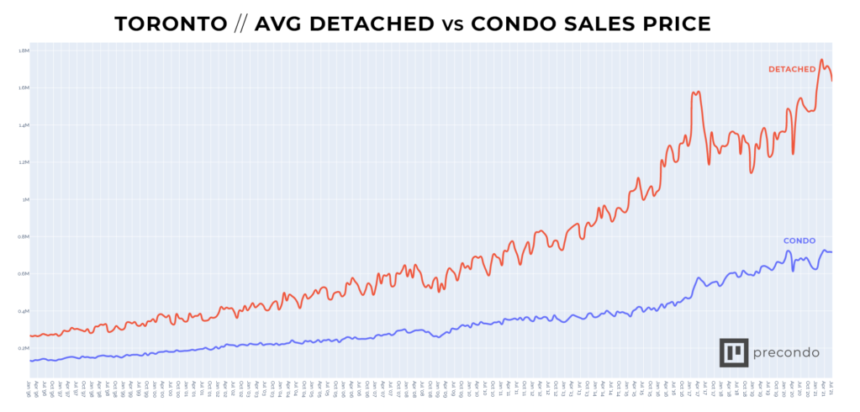
Historical data from the Toronto Real Estate Board shows that average home prices fell by 27.5% between 1989 and 1996. TD Economics reports that inflation-adjusted prices plunged by 32% over that seven-year period. Source: UrbanToronto.
Rob Goodall, CEO of CMCC and Atrium, notes that the early 1990s impacted every sector of real estate. He describes the current situation as the second worst downturn in his 40-year career, though he emphasizes it is largely concentrated in residential high-rise projects.
Interest rates during the 1990s were significantly higher than today. In the spring of 1990, five-year conventional mortgage rates reached 14.25%.
Despite these pressures, the market today benefits from stronger financial foundations. Pension funds now hold 15% to 20% of their assets in real estate, and REIT leverage is typically maintained at or below 50%.
This is the second worst downturn I’ve seen in my 40-year career, but it’s not as severe as the early 90s, and it’s very much oriented to residential this time.
Rob Goodall, CEO of CMCC and Atrium

Structural Safeguards and Lending Standards
The Canadian Mortgage and Housing Corporation identifies a structural housing shortage as a key differentiator today. Unlike the 1990s, which suffered from speculative overbuilding, current supply constraints limit the potential for a total price floor collapse.
Lending requirements have also tightened significantly. CMHC reports that developers must now pre-sell over 70% of condo units before construction begins. This is a sharp increase from the roughly 50% requirement common in the late 1980s.
Richard Munroe, president and COO of CMCC, explains that the loss of condo pre-sales has created a major financing hurdle. Landowners now face higher carrying costs or must shift toward rental development, which requires more equity.
These constraints on new housing supply act as a double-edged sword. While they prevent oversupply, they also limit the volume of new units entering the market, keeping prices elevated despite the broader housing correction.
Financing Options for Modern Developers
Developers currently face a challenging environment where traditional bank debt is often insufficient. CMCC is responding by providing mezzanine loans, which act as secondary financing behind conventional construction loans.
These loans help developers reduce their required equity contribution. For example, CMCC recently provided a $15 million mezzanine loan for a 50-storey rental project in midtown Toronto, supporting $195 million in senior bank financing.
Inventory financing is another tool used to manage unsold units. This involves a single loan secured by all unsold units in a project, which are released and paid down as individual sales occur.
Atrium Mortgage Investment Corporation, which maintains a portfolio of approximately $896 million as of March 2026, focuses on properties with high resale liquidity. This disciplined approach helps the firm protect capital while supporting established clients.
- Mezzanine loans: Secondary financing to reduce equity requirements for developers.
- Inventory loans: Single-security loans for unsold units that pay down as sales close.
- Insured financing: CMHC-backed loans that can offer rates 75 to 100 basis points lower.
- Bridge lending: Short-term capital for industrial, retail, and rental apartment properties.
- Equity-based rental development: A shift toward rental projects requiring higher upfront capital.
Analysis of Market Resilience
Launch Len Media argues that the Toronto market is structurally more resilient than it was in the 1990s. The combination of lower leverage and stricter pre-sale requirements creates a barrier against the type of speculative bubble that caused the previous crash.
A fair counterpoint is that the current high-interest-rate environment and investor distress in the condo sector could still lead to a prolonged period of stagnation. If economic growth fails to materialize, the market could face a lost decade similar to the 1990s.
However, the structural housing shortage remains a powerful force. As long as supply remains constrained, the downside risk for property values is likely capped compared to the 1990s.
The ability of firms like CMCC to pivot toward bridge lending and insured financing demonstrates a level of market adaptability that was less prevalent during the last major recession.
What Readers Can Do
If you are a developer or investor, focus on projects with high resale liquidity and established borrower track records. Diversifying into rental properties may offer more stability than pure condo-based models in the current climate.
Monitor bond yields and consumer confidence closely, as these are the primary drivers for a market recovery. Stable or lower bond yields are essential for renewed resale activity and construction viability.
Consult with specialized lenders who offer mezzanine or inventory financing if you are struggling with construction debt. These tools can provide the necessary liquidity to bridge the gap until market conditions improve.
Keep an eye on government housing policy and HST rebates, which have already shown effectiveness in moving standing inventory. Understanding these incentives can help you time your entry or exit from the market more effectively.
Frequently Asked Questions
How does current REIT leverage compare to the 1990s?
Current REIT leverage is typically maintained at or below 50%, providing a much more stable financial foundation than in previous decades.
Why is the current housing downturn considered less severe than the 1990s?
While the high-rise residential sector is struggling, the broader market is more stable due to stricter lending standards, lower leverage, and a structural housing shortage.
What role does CMHC play in today’s housing market?
CMHC provides insured financing that can lower interest rates by 75 to 100 basis points, which is often the deciding factor in the viability of rental housing projects.
Related coverage on LaunchLen Media: Ontario Housing Market Forecast Shows Modest 2027 Rebound and Ontario Mortgage Arrears Forecast to Climb Through Mid-2027.
For official information, see Canada Mortgage and Housing Corporation.