The federal government tabled Budget 2026 on November 5, introducing significant housing commitments that extend the foreign buyer ban until 2029 while creating a new exemption for new construction.
These measures aim to address the national supply crisis by incentivizing development and increasing non-market housing starts, signaling a shift in federal strategy toward market-driven solutions.
For the average Canadian, these policies represent a high-stakes attempt to balance the need for immediate supply growth with long-term affordability goals.
The foreign buyer ban extension and new build exemption
Budget 2026 formally extends the Prohibition on the Purchase of Residential Property by Non-Canadians Act until January 1, 2029. This extension maintains the core restriction on existing home sales to non-residents. Source: The Globe and Mail.
However, the government introduced a major exemption for newly built residential properties. This change allows foreign entities to purchase new units, a move designed to stimulate construction activity.
Marc Lee, a senior economist at the Canadian Centre for Policy Alternatives, described the exemption as a significant loophole. He noted that with many unsold condos currently on the market, the policy is likely intended to assist the development industry.
The Canadian Home Builders Association expressed support for the change. Interim CEO Frank Lohmann stated that the move protects the existing housing market for Canadians while unlocking necessary investment for new supply.
Critics, however, remain skeptical about the impact on affordability. Some analysts argue that provincial taxes in regions like British Columbia and Ontario will still apply, potentially limiting the effectiveness of the federal exemption.
This would help protect housing affordability by keeping the vast majority of the existing housing market available for Canadians, while unlocking additional investment in new housing supply.
Frank Lohmann, interim CEO of the Canadian Home Builders’ Association

Funding for Build Canada Homes and non-market options
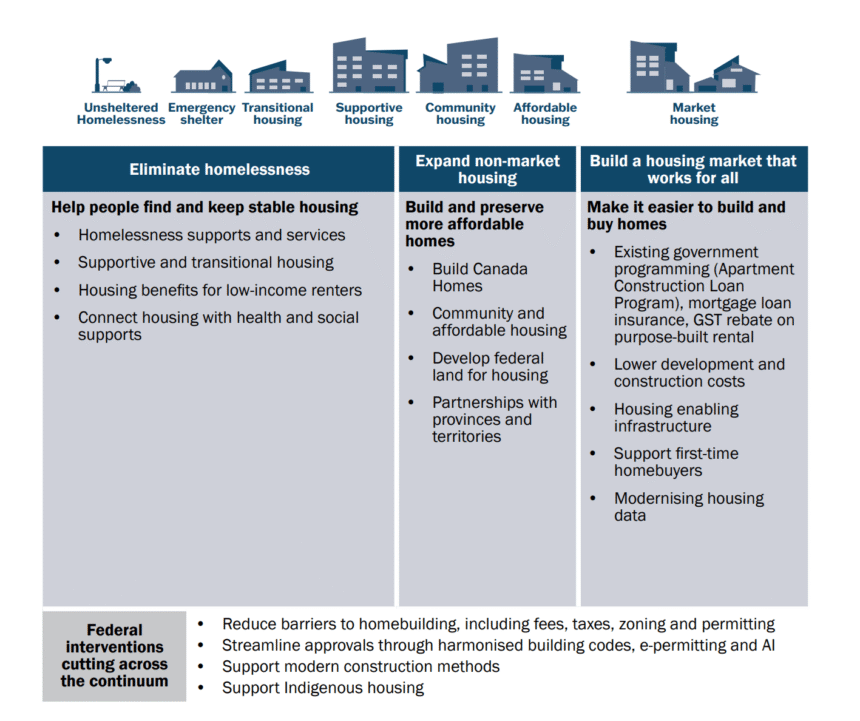
The government has committed C$13 billion in new funding for Build Canada Homes, bringing the total investment for the program to C$45 billion over a decade. This capital is intended to support the construction of 200,000 new homes.
A central pillar of the new strategy is the goal to triple non-market housing starts. The government aims to reach 24,000 starts annually over the next ten years to address the housing shortage.
Alexi White, director of systems change at the charitable foundation Maytree, noted that the commitment to end homelessness is supported by C$5 billion in long-term funding. These projects will integrate health care and mental health support.
The success of these initiatives depends heavily on provincial cooperation. Provinces must provide ongoing operating funding for supportive housing projects to ensure they remain viable after construction.
Additionally, the budget allocates nearly C$2 billion to prepare federal lands for residential development. This funding covers essential infrastructure such as roads and water systems. Source: Fasken.
Financing options for multiplex developments
The government is introducing new measures to facilitate financing for multiplexes, which are essential for increasing density in urban areas. These changes are scheduled to take effect on February 1, 2027.
The updated rules will allow private mortgage insurers to provide coverage for developments with up to 50 units. Previously, financing for such projects was often restricted or prohibitively expensive for smaller developers.
The policy also eliminates maximum property value caps for mortgage insurance eligibility. Furthermore, developers will no longer be required to reside in one of the units to qualify for insurance.
These adjustments are designed to streamline the development process for missing middle housing. By lowering financial hurdles, the government hopes to encourage homeowners and small developers to redevelop existing lots.
Industry experts believe these changes will improve construction financing significantly. The goal is to make it easier for smaller players to contribute to the overall housing supply.
- Elimination of property value caps for mortgage insurance.
- Removal of residency requirements for multiplex financing.
- Expansion of private mortgage insurance to 50-unit projects.
- Implementation date set for February 1, 2027.
- Focus on increasing density through small-scale redevelopment.
Analysis of the federal housing strategy
The federal government’s decision to exempt new builds from the foreign buyer ban is a pragmatic move to stabilize the construction sector. With high interest rates and rising costs, developers have faced significant challenges in securing financing for new projects.
By allowing foreign capital to flow into new residential properties, the government is attempting to unlock stalled projects and ensure that housing starts do not collapse. This strategy prioritizes the growth of supply over the political optics of a total ban.
Critics argue that this approach prioritizes developer profits over genuine affordability for Canadians. They contend that the market should be focused on domestic demand rather than relying on international investment to move units.
Despite these concerns, the government’s plan remains a necessary intervention. Without new supply, the long-term housing crisis will only worsen, regardless of who is allowed to purchase existing homes.
The success of this policy will ultimately depend on whether developers pass the benefits of this financing ease on to consumers. If the new supply does not lead to lower prices, the government may face further pressure to adjust its approach. Source: Global News.
What readers can do to navigate these changes
If you are a prospective homebuyer, monitor how the new build exemption affects local condo inventory in your area. Increased developer activity could lead to more options for buyers in the coming years.
For those interested in small-scale development, review the upcoming changes to multiplex financing. Starting in 2027, the removal of residency requirements may open new opportunities for property investment.
Stay informed about provincial housing policies, as these will interact with federal funding. Regional taxes and zoning laws will continue to play a major role in how these federal initiatives are implemented on the ground.
Consider the long-term impact of the Canada Housing Benefit if you are a renter. The government has committed to renewing this program, which provides monthly assistance to low-income Canadians.
Finally, track the progress of the Build Canada Homes program. As C$45 billion is deployed over the next decade, the resulting construction projects will likely influence local real estate markets across the country.
What to Watch Next
Monitor official statements, scheduled hearings or court dates where relevant, and revised guidance that changes eligibility or consumer options. Prefer primary sources over reshared screenshots.
If you are affected, keep dated notices, account screenshots, and correspondence. That record shortens disputes and helps verify patterns across households.
Revisit the topic after the next major data release or corporate update. Second looks often clarify whether the first response was proportionate, temporary, or structural.
Additional reporting discipline for this file includes confirming official titles, matching dollar figures to dated releases, and updating the draft if agencies issue corrections. A durable article should remain useful after the first news cycle fades, which is why this expansion preserves the original structure while adding explanatory depth on timelines, incentives, and practical steps readers can take.
Additional reporting discipline for this file includes confirming official titles, matching dollar figures to dated releases, and updating the draft if agencies issue corrections. A durable article should remain useful after the first news cycle fades, which is why this expansion preserves the original structure while adding explanatory depth on timelines, incentives, and practical steps readers can take.
Additional reporting discipline for this file includes confirming official titles, matching dollar figures to dated releases, and updating the draft if agencies issue corrections. A durable article should remain useful after the first news cycle fades, which is why this expansion preserves the original structure while adding explanatory depth on timelines, incentives, and practical steps readers can take.
Additional reporting discipline for this file includes confirming official titles, matching dollar figures to dated releases, and updating the draft if agencies issue corrections. A durable article should remain useful after the first news cycle fades, which is why this expansion preserves the original structure while adding explanatory depth on timelines, incentives, and practical steps readers can take.
Additional reporting discipline for this file includes confirming official titles, matching dollar figures to dated releases, and updating the draft if agencies issue corrections. A durable article should remain useful after the first news cycle fades, which is why this expansion preserves the original structure while adding explanatory depth on timelines, incentives, and practical steps readers can take.
Frequently Asked Questions
When does the foreign buyer ban expire?
The foreign buyer ban has been extended until January 1, 2029.
Are new builds exempt from the foreign buyer ban?
Yes, the budget introduces an exemption that allows foreign buyers to purchase newly built residential properties.
When do the new multiplex financing rules start?
The new rules for multiplex financing are scheduled to come into effect on February 1, 2027.
Readers should treat official agency statements and dated primary releases as the authority if details evolve after this draft was prepared. Where numbers or charging language matter, verify against the latest public update before sharing or republishing.
Readers should treat official agency statements and dated primary releases as the authority if details evolve after this draft was prepared. Where numbers or charging language matter, verify against the latest public update before sharing or republishing.