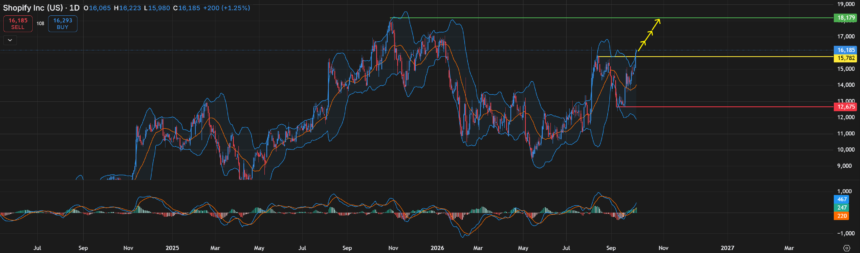
Shopify stock experienced significant price swings following the company’s November 3, 2026, earnings release. While revenue grew 32% to $3.74 billion, investors responded to valuation concerns by driving shares lower.
This volatility highlights the tension between high-growth performance and market expectations. For investors using a Tax-Free Savings Account for long-term goals, the current landscape requires a careful assessment of business fundamentals versus entry price.
Financial Performance and Market Data
Shopify reported robust financial results for the third quarter of 2026. According to company data, revenue reached $3.74 billion, marking a 32% increase compared to the same period in 2025.
The company also reported a 22% free cash flow margin for the quarter. This metric indicates that for every dollar of sales, Shopify generated $0.22 in free cash flow, providing a stable foundation for ongoing operations and investment.
Gross Merchandise Volume, a key indicator of platform activity, hit $119 billion in the third quarter. This represented 29.5% growth, according to data from Investing.com.
Despite these figures, the stock faced downward pressure immediately following the November 3, 2026, announcement. As of November 6, 2026, the stock was trading at approximately CA$211.36 on the Toronto Stock Exchange, according to Google Finance.

Valuation and the TFSA Context
Using a TFSA for long-term investments offers tax advantages, but it does not protect against poor entry prices. A 10-year horizon provides time for a business to grow, yet it also exposes the portfolio to the risk of overpaying for growth that may not materialize as expected.
The Canada Revenue Agency notes that while gains inside a TFSA are tax-free, investment losses do not create replacement contribution room. This makes capital preservation a critical component of any long-term strategy.
Before the earnings report, Shopify shares were trading at a premium, with some estimates placing the valuation near 70 times forecast earnings. This high multiple means that any sign of slowing growth or increased spending can trigger a rapid correction.
Analysts have set an average 12-month price target for Shopify of approximately $176 USD, according to Investing.com. This target suggests that some market observers believe the current valuation may be stretched relative to near-term growth projections.
Options for Long-Term Investors
Investors looking to gain exposure to Shopify within a tax-advantaged account have several tactical approaches. These methods focus on managing risk while maintaining exposure to the company’s growth trajectory.
The following list outlines strategies for managing a position in high-growth technology stocks like Shopify within a long-term portfolio.
- Dollar-cost averaging: Build your position in small, periodic increments to avoid the risk of deploying all capital at a market peak.
- Diversification: Ensure Shopify represents only a portion of your total portfolio to protect against sector-specific volatility.
- Focus on fundamentals: Monitor free cash flow and GMV growth rather than reacting to daily price fluctuations.
- Long-term horizon: Maintain a 10-year outlook to allow the business to compound earnings and overcome short-term market noise.
Analysis of Growth and Risk
Shopify remains a compelling candidate for long-term growth due to its essential role in the e-commerce ecosystem. Its ability to serve merchants across various channels, including AI-driven tools, provides a clear path for revenue expansion.
However, the counterpoint remains the stock’s high valuation. Skeptics argue that the company’s sensitivity to AI infrastructure costs and consumer spending habits makes it a volatile asset that may struggle to consistently meet the market’s aggressive expectations.
The business model is fundamentally sound, as evidenced by the 22% free cash flow margin. This distinguishes Shopify from growth companies that rely on constant capital raises to fund basic operations.
Investors who believe in the company’s long-term potential should view earnings-day volatility as a potential entry point rather than a signal to exit. Price discipline is the primary tool for mitigating the risks associated with high-growth premiums.
The business is generating cash while expanding, giving patient investors something substantial to own through the noise.
LaunchLen Media Analysis
Next Steps for Your Portfolio
If you are considering adding Shopify to your TFSA, start by evaluating your current asset allocation. Ensure that your total portfolio is diversified enough to withstand the volatility inherent in technology stocks.
Consider using a staged entry strategy. By purchasing a small position initially, you can gain exposure to the company’s growth while retaining the ability to add more shares if the price becomes more attractive over time.
Review your long-term goals and ensure they align with the risks of growth-oriented investing. For those focused on retirement planning, maintaining a balance between stable dividend payers and high-growth assets is often the most effective approach.
Stay informed by monitoring quarterly financial reports and analyst updates. Consistent tracking of GMV and free cash flow will help you determine if the company’s growth narrative remains intact.
Frequently Asked Questions
Is Shopify stock a good choice for a TFSA?
Shopify offers high growth potential, but its valuation can be volatile. It is best suited for investors with a long-term horizon who can tolerate price swings.
What should I do if my stock investment loses value in a TFSA?
Losses in a TFSA do not provide tax deductions or replacement contribution room. It is important to focus on the long-term viability of the underlying business.
How does Shopify generate revenue?
Shopify earns money by providing software, payment tools, and other services to merchants who operate online and in physical stores.
Readers comparing growth names inside a registered account may also find our note on maximizing TFSA room before 2026 ends useful, alongside coverage of how the Bank of Canada frames energy-price inflation risk.
Primary figures cited above should be checked against Shopify’s investor relations releases.