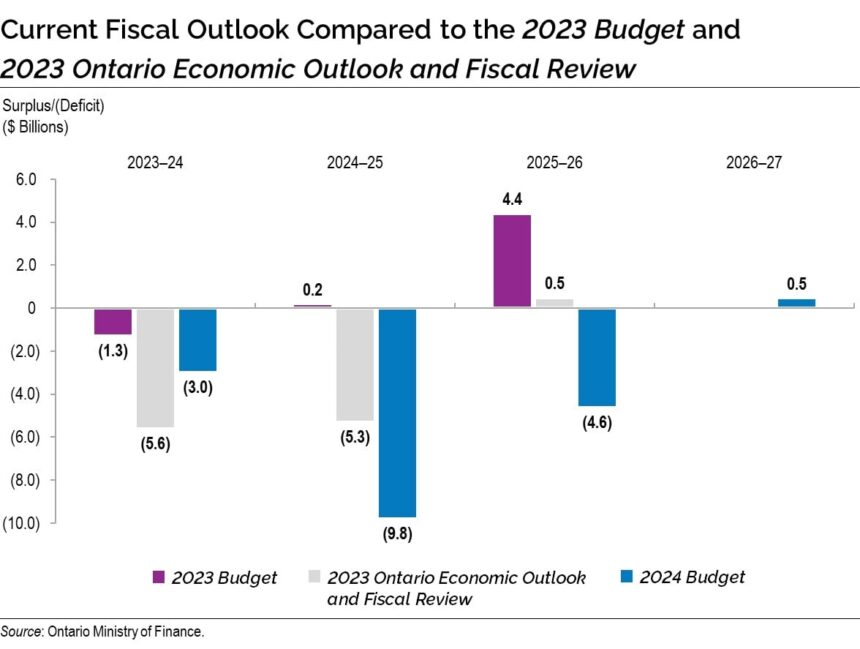
Ontario Finance Minister Peter Bethlenfalvy announced on October 29, 2026, that the provincial deficit has climbed to $16.9 billion. This figure marks a significant 22 percent increase over the $13.8 billion deficit originally projected in the March 2026 budget.
This fiscal shift forces the province to delay its return to a balanced budget until the 2029-30 fiscal year. Launch Len views this deficit spending as a necessary, if painful, shield against U.S. trade volatility intended to protect the province’s core industrial sectors.
The stakes for taxpayers remain high as the government navigates a cooling economy and mounting external pressures. Failure to manage these fiscal concerns could lead to long-term debt sustainability issues for the province.
The Scale of the Fiscal Deterioration
The latest economic update confirms that Ontario is facing a sharper fiscal decline than anticipated earlier this year. The $16.9 billion deficit projection aligns with warnings issued by the Financial Accountability Office of Ontario in September 2026. Source: CityNews Ottawa.
Minister Bethlenfalvy pointed to external economic headwinds as the primary drivers of this trend. U.S. tariffs on steel and automotive products have significantly hampered the province’s manufacturing output.
Global energy price instability has further complicated the government’s revenue outlook. These factors combined to force a downward revision of real GDP growth to just 0.5 percent for 2026.
The government’s decision to increase its contingency fund by $3.8 billion reflects the uncertainty of the current trade environment. The total fund now stands at $4.9 billion to provide a buffer against further shocks.
Mechanics of the Budget Delay
The decision to delay the return to a balanced budget until 2029-30 represents a shift in the government’s long-term fiscal strategy. Officials argue that aggressive austerity during a trade war would exacerbate the economic downturn.
Instead, the province is prioritizing targeted support for sectors most impacted by international trade barriers. This approach requires maintaining higher spending levels to sustain employment in the automotive and manufacturing hubs.
The $8 billion tax relief package for businesses is designed to stimulate business investment despite the current climate. By lowering the cost of doing business, the government hopes to maintain competitiveness against U.S. counterparts.
This strategy relies on the assumption that trade tensions will eventually stabilize, allowing for a return to growth. Critics, however, argue that the repeated delays indicate a lack of fiscal discipline.
Strategic Options for Economic Stability
The government has outlined specific measures to navigate the current fiscal environment. These options focus on protecting the industrial base while managing the rising provincial debt load.
The following list details the primary strategies currently being deployed by the Ontario government to address the economic challenges:
The $8 billion tax relief package aims to lower costs for companies, specifically targeting those in the manufacturing sector to boost business investment.
The increased $4.9 billion contingency fund provides a liquid reserve to respond to sudden trade policy changes or energy price spikes without requiring immediate borrowing.
Delayed infrastructure projects are being re-evaluated to prioritize those with the highest potential for long-term economic return, effectively spreading costs over a longer time horizon.
Negotiations with federal counterparts are ongoing to secure additional support for the automotive sector, which remains the most vulnerable to U.S. tariff policy. Source: FAO Ontario.
We are facing unprecedented headwinds from our largest trading partner, and our priority must be to protect the jobs and industries that form the backbone of our economy.
Ontario Finance Minister Peter Bethlenfalvy
Analysis of the Fiscal Strategy
Launch Len maintains that the current deficit spending is a strategic necessity. By absorbing the shock of trade volatility, the province prevents a deeper recession that would be far more costly to resolve later.
The counterpoint, frequently raised by opposition critics, is that the government is failing to control its own spending. They argue that the province has become too reliant on debt to fund its operations.
While the criticism of fiscal discipline is valid, it ignores the reality of the current trade war. A premature return to a balanced budget would likely require drastic cuts to public services or tax hikes that would further stifle growth.
The government’s path remains a delicate balancing act. Success will depend on whether the $8 billion in tax relief can effectively catalyze growth before the debt-to-GDP ratio reaches unsustainable levels.
Next Steps for Ontario Taxpayers
If you are a business owner or investor in Ontario, you should monitor the implementation of the new tax relief measures. These incentives may offer significant savings for companies looking to expand operations.
For individual taxpayers, the primary concern is the potential impact on public services. Keep an eye on provincial budget updates in the coming months to see if specific programs face funding adjustments.
You should also track the progress of trade negotiations between Canada and the United States. Changes in tariff policies will be the most significant indicator of whether the province can return to a balanced budget by 2029.
Finally, review your own financial planning to account for potential shifts in the provincial economy. Staying informed on fiscal policy will help you anticipate changes in the local business climate.
Frequently Asked Questions
Why has the Ontario deficit increased so significantly?
The deficit rose due to U.S. tariffs on key manufacturing sectors and global energy instability, which reduced projected economic growth to 0.5 percent.
When does the government now expect to balance the budget?
The target for a balanced budget has been moved to the 2029-30 fiscal year.
What is the purpose of the $4.9 billion contingency fund?
The fund acts as a financial buffer to protect the province against unexpected economic shocks and trade-related risks.