The Ontario Ministry of Education confirmed in an October 30, 2026, memo that the ECE wage floor will remain at $25.86 per hour for 2027. This decision halts the annual $1-per-hour wage increase that had been in place for educators since 2024.
This policy shift threatens the long-term viability of the province’s child care system by failing to retain skilled professionals, according to sector advocates. LaunchLen Media views this as a short-sighted move that prioritizes immediate fiscal constraints over the essential infrastructure needed for economic growth.
The 2027 Funding Freeze Explained
The Ontario government finalized its funding guidelines for 2027, which explicitly freeze the ECE wage floor at the 2026 level of $25.86 per hour. This directive applies to all programs operating under the Canada-Wide Early Learning and Child Care (CWELCC) agreement. Source: CBC News.
The decision marks a significant departure from the previous trajectory, which saw a consistent $1-per-hour annual increase starting in 2024. Education Minister Paul Calandra defended the current framework by emphasizing the stability provided by the four-year extension of the federal agreement, which runs until 2031.
Minister Calandra stated that the government has successfully turned around a system that previously suffered from limited spaces and a lack of training. The province maintains that the current agreement keeps average parent fees at $19 per day, with a maximum cap of $22 per day.
However, the Ontario Coalition for Better Child Care (OCBCC) and the Association of Early Childhood Educators Ontario (AECEO) condemned the move during a press conference at Queen’s Park on November 4, 2026. They argue that the freeze ignores the rising cost of living and the critical need for competitive compensation to attract staff.
Freezing the wage floor and halting the annual one-dollar increase in 2027 is a devastating provincial policy decision for a sector already struggling to retain workers.
Carolyn Ferns, Public Policy Coordinator for the Ontario Coalition for Better Child Care

Staffing Shortages and Economic Impact
The current staffing crisis is characterized by a widely cited provincial staffing shortfall among registered early childhood educators (RECEs). This shortage forces many licensed operators to keep rooms closed, which in turn limits the number of available child care spaces for families.
Advocates point out that passion for the field is not enough to sustain a workforce facing significant financial pressure. Without regular wage increases, many educators are expected to leave the profession for sectors offering higher pay and better benefits.
The stability of the entire child care sector relies on the retention of qualified staff. When centers cannot recruit or retain educators, waitlists grow, and parental workforce participation, particularly for mothers, is negatively impacted.
The OCBCC notes that to maintain purchasing power, wages would need to rise by at least 2% to 3% to match projected inflation for 2027. By freezing the wage floor, the government is effectively imposing a pay cut on those responsible for the province’s foundational economic infrastructure.
Demands for a Sustainable Wage Grid
The Care Counts campaign, led by the OCBCC and AECEO, has outlined specific demands for the government to stabilize the sector. These measures are intended to address the systemic wage inequity that has persisted for years. Source: Ontario Coalition for Better Child Care.
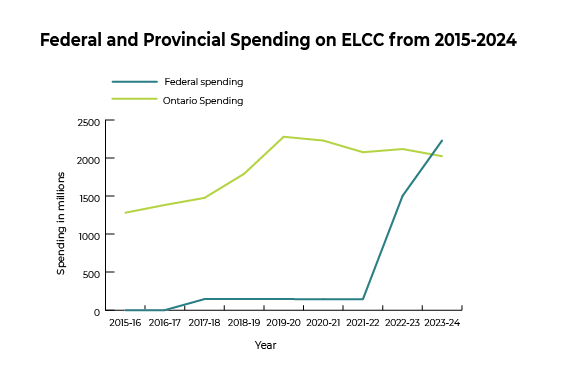
The proposed solutions focus on long-term retention rather than temporary fixes. Advocates argue that provincial funding must be increased to match federal investments, ensuring that programs can cover the real operational costs of providing quality care.
The following list details the primary demands presented by the coalition to the Ministry of Education:
Immediately restore and enhance annual wage increases to combat inflation.
Implement a formal provincial wage grid starting at $35 to $45 per hour for RECEs.
Establish a base rate of $28 per hour for early years staff.
Provide comprehensive health benefits and a pension plan for all educators.
Increase provincial funding to match federal investments in licensed child care.
Analysis of the Provincial Strategy
The provincial government’s decision to freeze wages appears to be a strategy to contain costs while meeting the federal requirement for low parent fees. By capping the wage floor, the government avoids the immediate pressure of increased operational expenses.
However, this approach overlooks the reality of the labor market. If the government fails to provide adequate provincial funding, the resulting staff turnover will likely cost more in the long run due to administrative churn and lost capacity. Source: CUPE.
The government argues that the CWELCC extension provides necessary stability for families and operators. While this is true for parents, it does not address the underlying issue of educator compensation, which is the primary driver of the current crisis.
The counterpoint from the province is that they are managing fiscal constraints within a complex federal-provincial agreement. Yet, if the goal is to expand child care access, the current policy acts as a barrier that prevents the system from reaching its full potential.
What Readers Can Do
If you are a parent or educator affected by these changes, you can engage with local representatives to voice your concerns regarding the current provincial funding model. Contacting your Member of Provincial Parliament (MPP) is a direct way to highlight how staffing shortages impact your local community.
You may also choose to support the Care Counts campaign by participating in local advocacy events or signing petitions organized by the OCBCC. Staying informed about the ongoing negotiations between the province and child care operators is essential for understanding how these policies affect your access to services.
Educators are encouraged to join professional associations to stay updated on collective bargaining efforts and advocacy initiatives. These groups provide resources for those seeking to advocate for better working conditions and a standardized wage grid.
Finally, monitor official updates from the Ministry of Education regarding any potential revisions to the 2027 guidelines. While the current freeze is in effect, public pressure remains a significant factor in shaping future policy decisions.
Frequently Asked Questions
Why was the ECE wage floor frozen for 2027?
The Ontario government has not provided a specific reason for the freeze beyond general fiscal management. Advocates believe it is a cost-saving measure that fails to account for the rising cost of living.
How many child care spaces are affected by the staffing shortage?
While the exact number of closed rooms varies, advocates estimate that staffing shortfalls among registered early childhood educators are currently preventing centers from operating at full capacity.
What happens to parent fees under the current agreement?
Parent fees remain capped at an average of $19 per day, with a maximum of $22 per day, as part of the extended Canada-Wide Early Learning and Child Care agreement.