A significant majority of Canadian homeowners who have navigated a mortgage renewal since January 2025 report higher borrowing costs. According to data from Rates.ca, 82% of these individuals experienced increased interest rates upon renewing their loans.
This trend is forcing a permanent reduction in Canadian household discretionary spending and long-term savings goals. LaunchLen Media observes that the cumulative financial pressure from these renewals is fundamentally altering the consumption patterns of the average Canadian family.
The Scale of the Renewal Burden
The financial impact of mortgage renewals has become a defining issue for Canadian households. According to a July 2026 survey by Rates.ca and Leger, the vast majority of homeowners who renewed their mortgages since the start of 2025 faced higher interest rates.
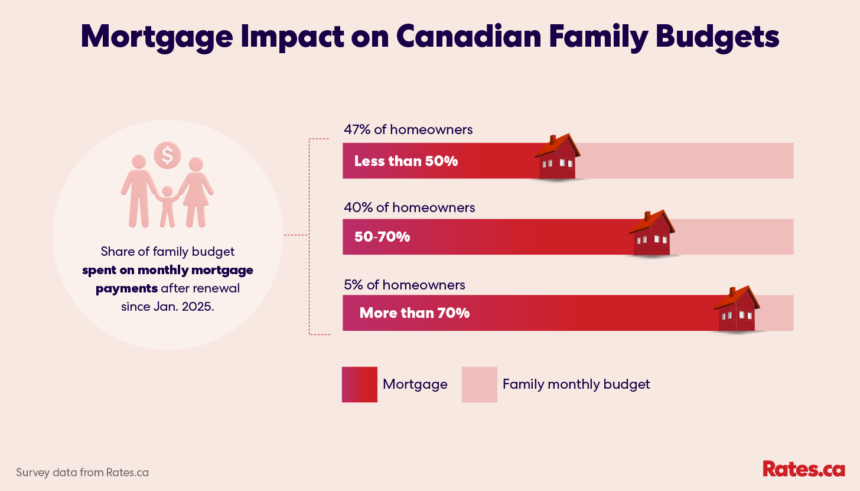
This shift has pushed a large segment of the population into a precarious financial position. Specifically, 45% of those surveyed stated that their housing costs now consume at least 50% of their total monthly household budget. Source: Rates.ca.
The strain is not limited to those who have already renewed. Many homeowners are looking ahead with significant apprehension regarding their own future obligations.
Data from TD Economics indicates that 67% of Canadian homeowners feel uneasy about their upcoming mortgage renewal. This sentiment reflects a broader concern about the sustainability of current debt-servicing levels in the face of persistent interest rate pressures.
While the peak of the renewal shock was noted by TD Economics in March 2026 to be fading, the lingering effects continue to weigh heavily on household balance sheets.

Mechanics of Household Adjustment
Canadian households are actively modifying their financial behavior to accommodate the increased cost of debt. According to findings reported by Wealth Professional, 56% of homeowners who anticipate higher payments upon renewal plan to reduce their overall household spending.
This reduction in spending is a direct response to the need to prioritize mortgage payments over discretionary purchases. The shift suggests that families are choosing to sacrifice lifestyle expenditures to maintain their housing security.
The data highlights a clear trend of fiscal contraction among Canadian homeowners. By cutting back on non-essential items, households are attempting to absorb the shock of higher interest rates without defaulting on their primary financial obligations.
This behavior is consistent with the broader economic environment where inflation and high debt-servicing costs have limited the disposable income available to consumers. The necessity of these cuts indicates that for many, the buffer for unexpected expenses has significantly thinned. Source: Royal LePage/CTV News.
As households adjust, the focus remains on ensuring that mortgage payments are met. This prioritization is a primary factor in the current stability of the housing market despite the significant increase in individual debt burdens.
Resilience Amidst Financial Strain
Despite the clear financial pressure reported by homeowners, the Canadian mortgage market has shown remarkable stability. Royal LePage reported in August 2026 that the national mortgage delinquency rate was 0.24% in the fourth quarter of 2025.
This figure is particularly notable given the environment of rising interest rates. It suggests that while households are under pressure, they have demonstrated an ability to manage their debt-servicing obligations effectively.
The lack of a widespread default crisis points to a high level of adaptability among Canadian homeowners. Many have successfully navigated the transition to higher rates by adjusting their budgets and prioritizing their mortgage commitments.
Furthermore, there is evidence that the intensity of the concern may be stabilizing. Royal LePage data from August 2026 shows that 38% of Canadians expected their mortgage payments to rise upon renewal, a decrease from 57% in early 2025.
This decline in the percentage of homeowners expecting payment hikes may indicate that the market is beginning to normalize. It also suggests that the initial fear surrounding the renewal cycle is being replaced by a more managed approach to long-term financial planning.
Strategic Analysis of the Renewal Landscape
LaunchLen Media maintains that the cumulative effect of mortgage renewals is forcing a permanent reduction in Canadian household discretionary spending and long-term savings goals. The data regarding budget allocation and planned spending cuts supports this outlook. Source: Wealth Professional.
When nearly half of a household budget is dedicated to housing, the capacity for long-term wealth accumulation through savings and investments is severely constrained. This shift represents a structural change in how Canadian families manage their finances.
Conversely, a fair counterpoint is that the lack of a widespread default crisis suggests that Canadian households have demonstrated remarkable resilience and adaptability in managing higher debt-servicing costs without destabilizing the broader economy.
Proponents of this view argue that the low delinquency rate is the most important metric for assessing the health of the housing market. They suggest that the ability of homeowners to absorb these costs without defaulting is a sign of underlying financial strength.
Ultimately, both perspectives hold merit. While households are clearly under significant strain and are altering their long-term financial trajectories, the system itself has remained stable, preventing a broader economic crisis.
Steps for Managing Your Renewal
Homeowners facing an upcoming renewal should take proactive steps to assess their financial position. Reviewing your monthly budget is the first step in understanding how much room you have to absorb a potential increase in payments.
Consider speaking with a financial advisor or mortgage broker well in advance of your renewal date. Exploring different term lengths and payment options can help mitigate the impact of higher interest rates on your monthly cash flow.
It is also important to evaluate your long-term savings goals in light of your new housing costs. You may need to adjust your contributions to retirement accounts or other investment vehicles to ensure your financial plan remains viable.
Finally, monitor your spending habits closely. As indicated by the survey data, reducing non-essential expenses is a common and effective strategy used by many Canadians to manage the transition to higher borrowing costs.
Related reading and sources: why variable mortgage rates remain a rational choice in 2026.