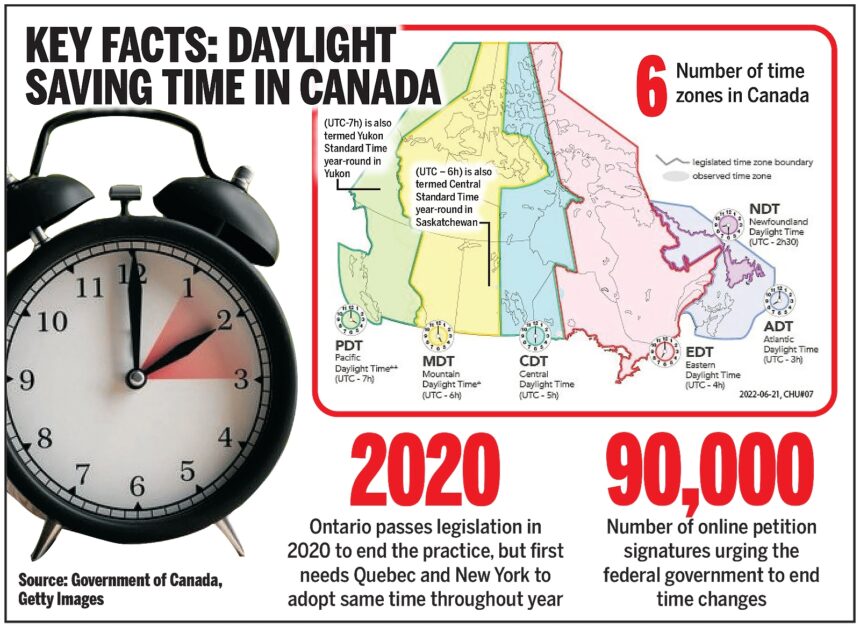
Ontario Premier Doug Ford stated on November 4, 2026, that he is very open to ending seasonal time changes. The move depends entirely on securing agreements from Quebec and New York to ensure regional economic stability.
This stance highlights the tension between public desire for an end to daylight saving time and the logistical realities of cross-border commerce. LaunchLen Media argues that prioritizing bureaucratic convenience over public health ignores the clear consensus for reform.
The Legislative Standoff
The Ontario legislature passed Bill 214, known as the Time Amendment Act, back in 2020. Despite this legislative victory, the bill has not been brought into force by proclamation, according to the Legislative Assembly of Ontario.
Premier Ford recently clarified his position during a press briefing on November 4, 2026. He said he is “easy going” on the idea but wants Ontario to stay aligned with Quebec and New York, particularly for the financial sector. Source: CP24.
The province maintains that its economic ties to Quebec and New York are too substantial to risk time zone fragmentation. Any unilateral change could create logistical nightmares for businesses operating across these borders, according to Global News reporting.
Other Canadian provinces have already moved forward with their own plans. Alberta, British Columbia and Manitoba now remain permanently on daylight time as of this year, creating a patchwork of time zones across the country.

Economic and Logistical Hurdles
The primary concern for the Ontario government is the synchronization of financial and transportation sectors. New York and Montreal serve as major hubs for Ontario businesses, and a one-hour discrepancy could complicate scheduling and communication.
Northwestern Ontario provides a unique case study in regional alignment. Regulatory changes to Ontario’s Time Act allow communities west of the 90th meridian to align with Manitoba and keep daylight time year-round.
This existing split demonstrates that the province is capable of managing different time zones internally. However, the government remains hesitant to apply this model to the entire province due to the scale of the economic integration with the United States and Quebec.
The government continues to monitor the situation in neighboring jurisdictions. Until those partners signal a willingness to move in lockstep, the ontario time change policy will likely remain in its current state of suspended animation.
Options for Regional Alignment
The debate often centers on whether to adopt permanent daylight saving time or permanent standard time. Experts remain divided on the best path forward for public health and economic efficiency.
Sleep specialists have voiced concerns regarding the potential for permanent daylight saving time. They argue that such a change would result in darker winter mornings, which could negatively impact student performance and worker safety.
The following options represent the current landscape of the debate:
1. Permanent Daylight Saving Time: Favored by those who prefer longer summer evenings and increased economic activity after work hours.
2. Permanent Standard Time: Supported by sleep researchers who argue it aligns better with the human circadian rhythm and ensures safer, brighter winter mornings.
3. Regional Synchronization: The current government preference, which requires consensus from Quebec and New York to prevent economic friction.
4. Status Quo: Maintaining the current biannual shift, which avoids regional disruption but continues to draw criticism from the public.
If Quebec and New York and the Eastern Corridor of the U.S. want to do it, I’m all there.
Ontario Premier Doug Ford, November 4, 2026, as reported by CP24
Analysis of the Policy Stagnation
The refusal to act independently suggests that the government views the economic cost of a time zone mismatch as higher than the public health cost of the current system. This perspective prioritizes corporate efficiency over the well-being of citizens.
Critics argue that the government could mitigate the impact of a time zone shift through clear communication and technology. They suggest that modern businesses are already accustomed to working across time zones globally.
A fair counterpoint is that the scale of cross-border trade in the Great Lakes region is unique. The sheer volume of daily commuters and freight transport between Ontario and New York creates a dependency that few other regions face.
Despite this, the continued delay leaves citizens frustrated. The push for an end to daylight saving time remains a popular sentiment that the government acknowledges but refuses to satisfy without external validation.
Next Steps for Residents
Residents who feel strongly about this issue should contact their local Member of Provincial Parliament to express their views. Public pressure remains one of the few levers available to move the government toward a decision.
Individuals can also participate in local consultations when they arise. Staying informed about the status of Bill 214 is essential for those tracking the legislative progress of this issue.
For businesses, it is wise to prepare for both scenarios. Developing internal protocols for potential time zone shifts can protect against future operational disruptions if the government eventually decides to act.
Finally, monitor official announcements from the Ontario government. Any shift in the stance of Quebec or New York will likely trigger a rapid response from the Premier’s office.
Frequently Asked Questions
Why hasn’t the Ontario government implemented Bill 214 yet?
The government is waiting for Quebec and New York to agree to a synchronized change to avoid economic and logistical friction.
Do any parts of Ontario currently use permanent daylight saving time?
Yes, communities in Northwestern Ontario west of the 90th meridian use permanent daylight saving time to align with Manitoba.
What are the health concerns regarding permanent daylight saving time?
Sleep experts warn that it would lead to darker winter mornings, which could negatively affect public health and safety.