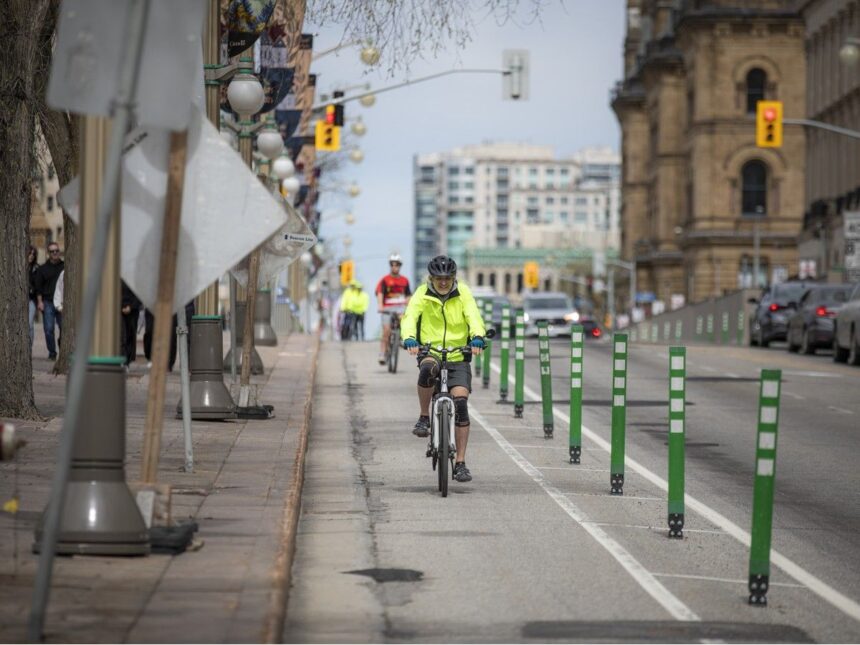
The Ontario government concluded the removal of 1.2 kilometres of bike lanes on Bloor Street West in Etobicoke on October 30, 2026. This action marks a significant shift in provincial policy regarding urban road design.
The Bloor Street bike lane removal signals a move toward prioritizing vehicle throughput over active transportation infrastructure. Launch Len Media views this as a regressive step that undermines long-term urban planning goals.
The project follows a contentious period of public protests and legal debates. The outcome highlights the tension between provincial authority and municipal planning autonomy.
The mechanics of the Bloor Street bike lane removal
The removal process on Bloor Street West began on October 13, 2026, and concluded on October 30, 2026. The work involved dismantling protected infrastructure such as curbs and delineators. Source: Government of Ontario.
The project targeted the stretch of road between Clissold Road and Royal York Road. The provincial government stated the goal was to restore motor vehicle lanes to their previous capacity.
Transportation Minister Prabmeet Sarkaria defended the move as a necessary measure to address traffic congestion. He argued that restoring road capacity is essential for the flow of goods and services.
The provincial government utilized its authority following an August 2026 Ontario Court of Appeal ruling. The court determined that decisions regarding road design are matters of provincial policy rather than municipal jurisdiction.
More Read

Financial disputes and project costs
A November 2024 staff report from the City of Toronto estimated the total cost to remove the full network of targeted bike lanes at $48 million. This figure included labor, materials, and traffic management.
Premier Doug Ford publicly challenged the accuracy of the city’s estimate. He labeled the $48 million figure as hogwash during a press briefing regarding provincial infrastructure spending.
The discrepancy highlights a broader disagreement between the provincial government and municipal officials. The province has not released a finalized budget for the total removal project.
The debate over costs reflects the broader fiscal challenges associated with altering established urban infrastructure. Critics argue that the funds could be better spent on improving local infrastructure needs.
Options for urban transit and road management
The provincial government has identified several strategies for managing traffic flow in Toronto. These options focus on increasing vehicle capacity on major arterial roads.
One option involves the complete removal of protected bike lanes on identified corridors. This approach aims to maximize the number of lanes available for private and commercial vehicles. Source: CityNews Toronto.
Another option is the implementation of synchronized traffic signals to improve throughput. The province suggests this technology can mitigate gridlock without requiring extensive road reconstruction.
A third option includes the expansion of transit-only lanes in specific areas. This strategy seeks to balance the needs of commuters while maintaining road capacity for essential traffic.
Finally, the province is considering provincial infrastructure grants to support road maintenance projects. These grants are intended to help municipalities address traffic issues while adhering to provincial design standards.
- Full removal of protected bike lanes on major arterial roads.
- Integration of advanced traffic signal synchronization systems.
- Expansion of dedicated transit lanes to improve bus efficiency.
- Distribution of provincial infrastructure grants for road upgrades.
Analysis of the provincial approach
Launch Len Media maintains that prioritizing vehicle throughput over established cycling infrastructure is a regressive approach to urban planning. This strategy ignores the growing demand for sustainable transportation options in dense urban centers.
The removal of bike lanes may lead to increased traffic risks for cyclists who are forced into shared lanes with motor vehicles. This shift contradicts modern urban design principles that emphasize safety and accessibility.
A fair counterpoint is that the provincial government is fulfilling a democratic mandate. Supporters argue that the government must address severe traffic gridlock that impacts the daily lives of thousands of commuters.
Local businesses and residents have expressed concerns regarding road accessibility and the impact of bike lanes on deliveries. The provincial government claims it is responding directly to these constituents.
Despite these arguments, the long-term impact of removing active transit infrastructure remains a point of contention. The province continues to face pressure to justify the necessity and cost of these interventions. Source: CBC News.
The province has finished removing bike lanes from a section of Bloor Street W. and will continue ripping them out of several other major arteries in Toronto.
Transportation Minister Prabmeet Sarkaria
Next steps for concerned residents
Residents who wish to voice their opinions on road design should contact their local provincial representatives. Public feedback is a primary channel for influencing future infrastructure policy.
You can also participate in municipal consultations regarding transportation planning. While the province holds final authority, local input remains vital for shaping the implementation of these policies.
Advocacy groups are continuing to monitor the situation and provide updates on upcoming road projects. Engaging with these organizations can help you stay informed about potential changes in your neighborhood.
Review the official provincial infrastructure plans to understand which corridors are slated for future modifications. Being informed allows for more effective participation in public debates.
Frequently Asked Questions
When was the bike lane removal on Bloor Street West completed?
The removal of the 1.2-kilometre section of bike lanes was completed on October 30, 2026.
What was the legal basis for the provincial government’s actions?
The Ontario Court of Appeal ruled in August 2026 that road design decisions are matters of provincial policy, granting the province authority over municipal decisions.
How much does the province estimate the removal project will cost?
The City of Toronto estimated the cost at $48 million, but Premier Doug Ford has publicly disputed this figure as inaccurate.
Related coverage on LaunchLen Media: Kitchener E-Bike Collision Victoria Street Sparks Safety Debate and Ontario Civil Projects Pipeline Surges With $25 Billion in New Activity.
For official information, see the Government of Ontario and the City of Toronto.