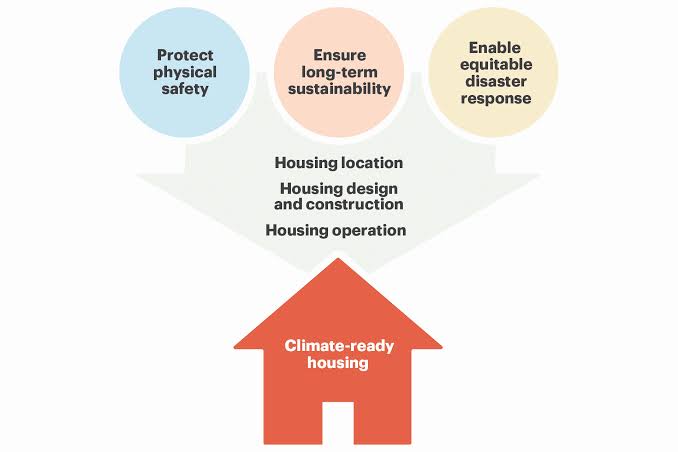
Canada faces a dual challenge as it attempts to resolve the national housing affordability crisis while confronting accelerating climate threats. The federal government aims to construct 5.8 million new homes by 2030 to stabilize the market, according to the Canada Mortgage and Housing Corporation.
This ambitious Canada housing strategy must account for environmental hazards to avoid long-term financial instability. LaunchLen Media believes that integrating climate resilience into site selection is essential to protecting the future value of Canadian residential assets.
The Scale of the Climate Risk
The Canadian Climate Institute estimates that without significant policy changes, over 540,000 new homes could be built in flood-hazard zones by 2030. Additionally, 220,000 units are slated for areas highly susceptible to wildfires. Source: The Hill Times.
These figures represent a significant portion of the 5.8 million homes targeted under the current Canada housing strategy. If these developments proceed without mitigation, the financial consequences for the national economy could be severe.
Research suggests that failure to integrate climate risk into housing development could result in up to $3 billion in annual damages from floods and wildfires. These costs would fall on homeowners, municipalities, and insurance providers.
The Intact Centre on Climate Adaptation has projected that these climate-related risks could lead to a 15% reduction in the value of Canadian residential properties by 2050. This depreciation would threaten the primary source of wealth for many Canadian households.

Regulatory Oversight and Financial Exposure
The Office of the Superintendent of Financial Institutions (OSFI) has recognized the threat that climate change poses to the banking system. Guideline B-15 now requires federally regulated financial institutions to manage and disclose climate-related risks.
This mandate includes physical risks to mortgage portfolios, such as properties located in high-hazard zones. Banks must now account for the possibility that collateral values could decline due to environmental degradation.
In 2025, OSFI initiated its first cycle of Climate Risk Returns for major Canadian banks and insurance groups. This data collection effort is designed to better quantify financial exposure to climate hazards across the country.
By requiring banks to report these exposures, regulators are indirectly pressuring developers to prioritize safer locations. Financial institutions may eventually limit lending for projects in high-risk areas to protect their balance sheets.
- Redirecting 3% of construction away from flood zones reduces risk by 80%.
- OSFI Guideline B-15 forces banks to disclose physical climate risks.
- Annual damages from climate events could reach $3 billion without intervention.
- Property values face a potential 15% decline by 2050 due to climate hazards.
- Climate Risk Returns are now mandatory for major Canadian financial institutions.
Strategic Options for Sustainable Development
To balance the need for housing with the reality of climate risk, policymakers and developers have several options. Focusing on high-density infill development in existing, safer urban areas is a primary alternative to greenfield expansion in high-hazard zones.
Another option is the implementation of stricter building codes in flood-prone regions. While this increases construction costs, it ensures that new homes are built to withstand extreme weather events, thereby protecting the long-term investment of the homeowner.
Public-private partnerships can also be utilized to fund climate-resilient infrastructure. By investing in flood mitigation systems, such as improved drainage or protective barriers, developers can make previously high-risk land viable for sustainable housing construction.
Finally, governments could implement zoning reforms that explicitly prohibit new residential developments in high-risk wildfire corridors. This approach prioritizes public safety and financial stability over the short-term goal of rapid expansion.
Analyzing the Policy Trade-offs
LaunchLen Media maintains that the Canada housing strategy must prioritize climate resilience to prevent future economic instability. Ignoring these risks today creates a moral and financial hazard that will be far more expensive to address tomorrow.
A fair counterpoint is that overly restrictive zoning based on climate risk models could exacerbate the immediate housing supply shortage. Critics argue that limiting development in certain areas will increase construction costs and delay the delivery of affordable units.
However, this view fails to account for the long-term cost of disaster recovery. Building in a flood zone does not solve the housing crisis if the resulting home becomes uninsurable or loses significant value within a decade.
The long-term health of the housing market depends on the durability of the assets being built. A strategy that ignores climate reality is not a solution but a deferral of a larger financial crisis.
The Canadian Climate Institute estimates that without policy changes, over 540,000 new homes could be built in flood-hazard zones and 220,000 in wildfire-prone areas by 2030.
Canadian Climate Institute
Actionable Steps for Homeowners and Investors
If you are looking to purchase a home, you should conduct thorough due diligence regarding the property’s location. Review local flood maps and wildfire risk assessments before finalizing any transaction to ensure your investment is secure.
Investors should monitor the climate risk disclosures of major Canadian banks. As OSFI continues to collect Climate Risk Returns, banks may adjust their mortgage lending criteria, which could impact property values in specific regions.
Advocate for municipal planning that emphasizes climate-resilient infrastructure. Supporting local initiatives that improve drainage and wildfire management can protect the value of your property and the broader community.
Stay informed about updates to the Canada housing strategy. Look for government announcements that link housing funding to climate mitigation requirements, as these will likely dictate where future development occurs.
Related coverage on LaunchLen Media: Ontario Boosts Flood Protection Funding to Enhance Predictive Modeling, Ontario Construction Overhauls Permitting to Boost Housing Supply.
Frequently Asked Questions
How does climate risk affect my mortgage?
If your home is located in a high-risk climate zone, you may face higher insurance premiums or difficulty obtaining coverage. Over time, banks may also tighten lending standards for properties with high physical risk profiles.
Are there specific zones to avoid when buying a home?
You should check official government flood maps and local wildfire hazard assessments. Properties in low-lying areas near water or in dense, fire-prone forest regions carry the highest physical risks.
What is OSFI Guideline B-15?
It is a regulatory requirement that forces federally regulated financial institutions to disclose and manage their exposure to climate-related financial risks. This helps ensure banks are prepared for the potential economic impacts of climate change.