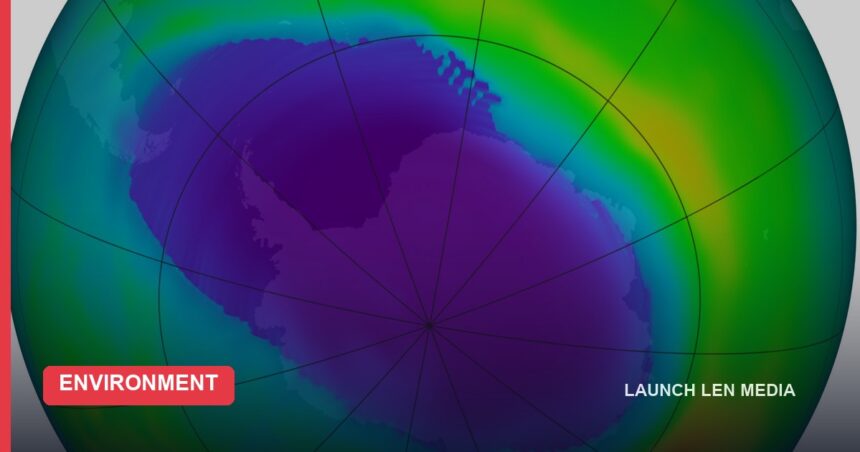
The hole in the ozone layer over Antarctica grew larger in 2026 than at any point in roughly a decade. Even so, NASA and the U.S. National Oceanic and Atmospheric Administration (NOAA) say the ozone layer remains on track for long-term recovery. Source: NASA.
- What NASA and NOAA Reported
- The 2026 Ozone Hole by the Numbers
- Why a Healing Ozone Layer Produced a Bigger Hole
- The Montreal Protocol Is Still Doing Its Job
- The Canadian Connection
- What It Means for Canada and the U.S.
- A Fair Counterpoint
- What Readers Can Do
- Frequently Asked Questions
- Sources and Further Reading
The two agencies ranked this year’s hole seventh largest by area in 48 years of monitoring. They also stressed that it was not as deep as the record holes of earlier decades, a sign that the chemistry driving depletion keeps weakening. Source: NASA Earth Observatory.
Here is what the 2026 numbers show, why weather rather than pollution made the hole bigger, and why this story still runs through Canada.
What NASA and NOAA Reported
On Nov. 4, NASA and NOAA published their annual assessment of the Antarctic ozone hole. During peak depletion season, from Sept. 7 to Oct. 13, the hole averaged about 25 million square kilometres (9.6 million square miles). Source: NASA.
Its largest single-day extent came on Sept. 18, at 27.1 million square kilometres (10.5 million square miles). For comparison, NASA says the largest hole since monitoring began reached its maximum in September 2000. Source: NASA.
Paul Newman has long led NASA’s ozone research team and is a senior scientist at the University of Maryland, Baltimore County. He said the hole has been forming later in recent years, a sign the ozone layer is healing. This year broke the pattern because a strong polar vortex kept depletion going. Source: NASA.
Europe’s monitoring services saw the same thing. The German Aerospace Center (DLR) reported that measurements from the TROPOMI instrument on the Sentinel-5P satellite showed an area of up to 27 million square kilometres as of Sept. 20. Source: DLR.
…allowing the hole to grow to proportions we haven't seen in a decade.
Paul Newman, NASA ozone research team lead, on the 2026 polar vortex

The 2026 Ozone Hole by the Numbers
Size and depth are measured separately, and in 2026 they told different stories. The hole was wide, but the thinnest ozone inside it was not close to a record. Source: NASA Earth Observatory.
The ozone hole is the area where ozone falls below 220 Dobson units. A Dobson unit is the standard measure of how much ozone sits in a column of air above a given spot. NASA notes that before 1979, readings below that threshold had never been observed. Source: NASA Earth Observatory.
27.1M km²
Peak one-day area, Sept. 18, 2026 (NASA)
7th
Largest mean area in 48 years of monitoring
105 DU
Lowest ozone over the South Pole, Oct. 17 (NOAA)
2070s
Expected recovery of the Antarctic ozone hole
| Measure | 2026 result | Record or reference | Source |
|---|---|---|---|
| Mean area, Sept. 7 to Oct. 13 | About 25 million km² | 7th largest of 48 years | NASA |
| Peak one-day area | 27.1 million km² (Sept. 18) | Largest peak: September 2000 (NASA) | NASA |
| Lowest ozone over South Pole | 105 DU (Oct. 17) | 92 DU in October 2006 | NASA/NOAA |
| Area on Sept. 12 (Copernicus) | About 25 million km² | Roughly 5 million km² above average | Down To Earth |
| Deepest hole on record | Not as deep as past large holes | 73 DU on Sept. 30, 1994 | NASA Earth Observatory |
Why a Healing Ozone Layer Produced a Bigger Hole
The short answer is weather in the stratosphere. The polar vortex is a ring of strong winds that circles Antarctica in winter and spring. NASA explains that it creates the cold conditions that let chlorine and bromine from human-made compounds destroy ozone. Source: NASA.
Amy Butler is a research scientist at NOAA’s Chemical Sciences Laboratory. She said the large weather systems that usually rise from the lower atmosphere and break up the vortex were especially weak in August and September. That kept the strongest winds several degrees of latitude away from the pole, widening the zone where depletion could happen. Source: NASA.
The Copernicus Atmosphere Monitoring Service (CAMS) tied the fast growth in early September to a sudden drop in minimum temperature about 20 kilometres above the South Pole. Its other indicators, including the lowest ozone values and the total ozone mass deficit, stayed close to average. Source: Down To Earth, citing Copernicus.
In other words, a cold, stable vortex gave the remaining chemicals more room to work. It did not mean more ozone-destroying chemicals were in the air.
Consider the contrast with 2025. The WMO says last year’s hole ranked among the five smallest since 1992. It was also the second year in a row that both its depth and size were well below the 1990 to 2010 average. Source: WMO.
NASA says year-to-year swings in the hole’s area and depth come from variations in stratospheric temperature and circulation. Ozone-depleting chemicals, by contrast, decline slowly over decades, so the jump from 2025 to 2026 is mostly a weather story. Source: NASA Earth Observatory.
The Montreal Protocol Is Still Doing Its Job
The ozone hole first drew global attention in 1985, when British Antarctic Survey scientists reported severe seasonal thinning over Antarctica. Researchers traced it to chlorofluorocarbons (CFCs), long-lived chemicals once common in household products such as refrigerators and aerosol sprays. Source: NASA Earth Observatory.
The response was the 1987 Montreal Protocol, which phased out the production and use of ozone-depleting substances. Stephen Montzka of NOAA’s Global Monitoring Laboratory said chlorine in the Antarctic stratosphere from those substances has fallen by about a third relative to 1980s levels. Source: NASA.
Newman put the effect in concrete terms. He said the 2026 hole could have been about 3.5 million square kilometres larger if ozone-depleting substances were still as common as they were at their peak in 2000. Source: NASA.
The World Meteorological Organization (WMO) reached a similar conclusion in its September bulletin. It said the 2025 hole ranked fourth to fifth smallest since 1992, and Secretary-General Celeste Saulo called the recovery an environmental success story. Source: WMO.
The Canadian Connection
The treaty carries a Canadian city’s name for a reason. According to the Government of Canada, the protocol was first signed in Montreal by 24 countries, including Canada, on Sept. 16, 1987. Canada ratified it on June 30, 1988, and it took effect here on April 1, 1989. Source: Government of Canada.
Canadian scientists also built some of the tools the world uses to track the problem. Environment and Climate Change Canada created the UV Index in 1992. The World Health Organization and the UN Environment Programme made it an international program in 1994, then built a global standard on the Canadian model in 2002. Source: Government of Canada.
Toronto-based data work continues today. The World Ozone and Ultraviolet Radiation Data Centre is one of six WMO world data centres. It is run by the Meteorological Service of Canada and holds records from more than 500 registered stations and over 150 contributors. Source: WOUDC.
- 1987: Montreal Protocol first signed in Montreal by 24 countries, including Canada.
- 1992: Environment and Climate Change Canada scientists create the UV Index.
- 2016: The Kigali Amendment adds hydrofluorocarbons (HFCs) to the protocol’s controls.
- 2019 and 2020: Canada cut HFC consumption by 13.8 percent and 23.6 percent, according to a 2022 federal page.
What It Means for Canada and the U.S.
The Antarctic hole forms over the far Southern Hemisphere, and none of the reports from NASA, NOAA, Copernicus or DLR described direct UV effects on Canada or the U.S. this year. That said, the WMO notes that significant ozone depletion also occurs in the Northern Hemisphere every five to 10 years. Source: WMO.
In 2025, total column ozone was below average across a large region stretching from Greenland and Europe to Central Asia and northern Japan, the WMO bulletin said. Northern readings like these are why Canada’s monitoring network still matters. Source: WMO.
There is also a climate link that touches North American households. The Kigali Amendment targets HFCs, the chemicals that replaced CFCs in fridges and air conditioners. They do not harm ozone, but the WMO says some trap thousands of times more heat than carbon dioxide. Source: WMO.
Ottawa says the Montreal Protocol has averted greenhouse gas emissions equivalent to more than 135 billion tonnes of carbon dioxide. That figure comes from a federal page last updated in 2022, so treat it as a dated estimate. For Canada’s broader emissions picture, see our report on Canada’s 2024 greenhouse gas inventory. Source: Government of Canada.
A Fair Counterpoint
A fair counterpoint is that recovery is slow and uneven. NASA says chlorine and other ozone-depleting substances in the stratosphere will not fall back to pre-1980 levels until later this century. Old fridges, insulation and landfills can keep leaking these legacy compounds for decades. Source: NASA Earth Observatory. Source: NASA.
Recovery dates also differ by source and region. A 2022 Government of Canada page says the ozone layer should return to pre-1980 levels by 2050, while NASA puts recovery of the Antarctic hole in the 2070s. Source: Government of Canada. Source: NASA.
Climate change complicates the picture. Down To Earth’s report on the Copernicus findings notes that global warming tends to cool the stratosphere, which favours the polar clouds that help destroy ozone. Source: Down To Earth, citing Copernicus.
Monitoring is thinning too. The WMO says active Dobson and Brewer ground stations fell from around 130 in the early 2000s to 110 today, often in places where observations were already sparse. It also flagged unexpected emissions of CFC-11 until 2018 and of HFC-23. Source: WMO.
What Readers Can Do
The ozone layer is a slow-moving problem, but a few practical steps follow from what the agencies reported. None of them require tracking the Antarctic hole yourself.
- Check the UV Index in your local forecast. It was designed in Canada to help people avoid overexposure to the sun, and the WMO says high-UV days have become more frequent in some regions.
- When replacing an old fridge, freezer or air conditioner, ask the retailer or your municipality whether the refrigerant will be recovered. NASA notes that legacy compounds can leach from old products and landfills for decades.
- Follow NASA’s Ozone Watch and NOAA’s South Pole ozone data if you want season-by-season updates. Both are linked from the NASA report.
- Treat single-year headlines with caution. Year-to-year swings are driven by weather, and the long-term trend is what scientists use to judge recovery.
Frequently Asked Questions
Is the ozone hole getting worse again?
No. NASA and NOAA say the 2026 hole was larger because of an unusually strong polar vortex, not because of more ozone-destroying chemicals. Chlorine from those chemicals in the Antarctic stratosphere is down about a third from 1980s levels.
How big was the 2026 ozone hole?
It averaged about 25 million square kilometres between Sept. 7 and Oct. 13 and peaked at 27.1 million square kilometres on Sept. 18. That ranks seventh largest by mean area in 48 years of monitoring.
When will the ozone hole close for good?
NASA estimates the Antarctic ozone hole will recover by the 2070s as legacy compounds break down. A 2022 Government of Canada page gives 2050 for the ozone layer’s return to pre-1980 levels, so estimates vary by region and source.
Does the Antarctic ozone hole affect Canadians?
The hole forms over Antarctica, and this year’s reports did not describe direct effects on Canada. The WMO says significant ozone depletion also occurs in the Northern Hemisphere every five to 10 years, which is why monitoring continues.
What is Canada’s role in protecting the ozone layer?
The Montreal Protocol was first signed in Montreal in 1987, and Canada ratified it in 1988. Canadian government scientists created the UV Index in 1992, and Canada operates the WMO’s world ozone and UV data centre.
Sources and Further Reading
- NASA: NASA, NOAA Track 2026 Antarctic Ozone Hole (Nov. 4, 2026)
- NASA Earth Observatory: Ozone Hole Reaches Its 2026 Maximum (Nov. 9, 2026)
- World Meteorological Organization: Ozone bulletin press release (Sept. 16, 2026)
- German Aerospace Center (DLR): Ozone Hole 2026
- Down To Earth, citing Copernicus Atmosphere Monitoring Service
- Government of Canada: Ozone layer depletion, Montreal Protocol
- Government of Canada: About the UV Index
- World Ozone and Ultraviolet Radiation Data Centre: About WOUDC
This article was researched with AI assistance and checked against the sources listed above. Facts are current as of the publication date; follow the source links for updates.