National Beverage Corp. reported flat net sales of $330.7 million for the first quarter of 2027, according to company filings released September 10, 2026. The earnings per share of $0.50 fell significantly short of the $0.62 consensus estimate from analysts.
This performance highlights a critical juncture for the company as it struggles with rising input costs within the broader beverage industry. Launch Len Media views the firm’s reliance on premium pricing to mask volume declines as a precarious strategy that may struggle to hold up against shifting consumer spending habits.
The Q1 2027 Financial Reality
The fiscal results for the first quarter of 2027 showed little movement in top-line revenue for National Beverage Corp. Net sales reached $330.7 million, which matched the figures from the same period in 2026, according to Nasdaq reports.
Profitability took a sharper hit than revenue. The company reported earnings per share of $0.50, missing the $0.62 target set by market analysts, as noted by Investing.com.
Operational costs were the primary driver of this earnings miss. Gross margins compressed to 35% during the quarter, largely due to external inflationary pressures.
Aluminum costs represented a significant burden on the bottom line. According to Stock Titan, these costs alone created a 600 basis-point headwind for the company during the quarter.

Mechanics of Margin Compression
National Beverage Corp. relies on a hybrid distribution model that includes both warehouse and direct-store delivery. This model is designed to optimize reach across the United States and Canada, but it is highly sensitive to logistics and raw material pricing.
The 600 basis-point impact from aluminum costs illustrates the vulnerability of the company to commodity price volatility. When raw material costs rise, the company must choose between absorbing the expense or passing it to the consumer.
The current data suggests that the company has opted to maintain premium pricing to protect its brand positioning. However, the flat sales figure indicates that this strategy is not driving the volume growth needed to offset the higher cost of goods sold.
Management has historically avoided debt, which provides a buffer against interest rate fluctuations. This capital structure allowed for a substantial return of cash to shareholders through a special dividend. Source: Investing.com.
Evaluating Shareholder Returns and Valuation
Investors often look to National Beverage Corp. for its history of capital allocation. On July 30, 2026, the company paid a special dividend of $3.25 per share, totaling $304.2 million, according to MarketBeat.
This payout serves as a primary argument for proponents who view the stock as a resilient, cash-generative asset. The company’s debt-free status allows it to sustain such payments even when operational margins are under pressure.
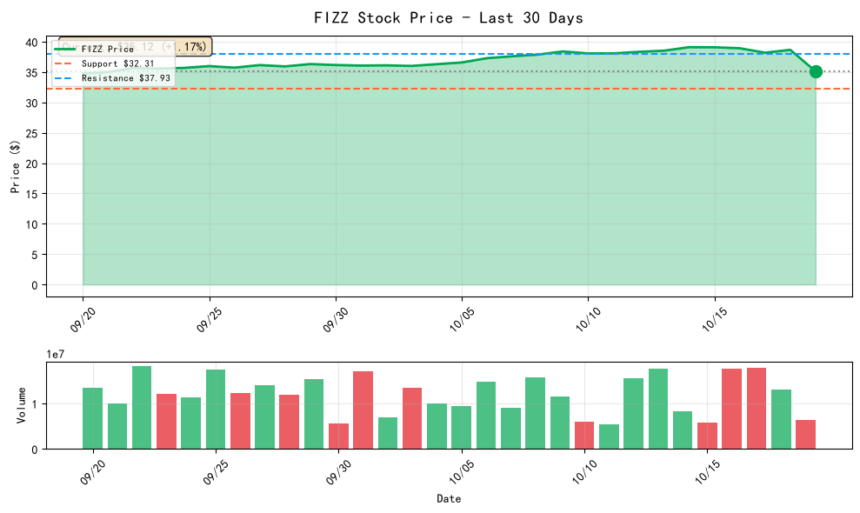
However, the market sentiment remains cautious regarding future price appreciation. As of late October 2026, the consensus analyst price target for FIZZ stands at $31.00, according to MarketBeat data.
The stock has recently traded near $35.82, suggesting that the current market price may be elevated relative to the consensus outlook. Investors should weigh the dividend yield against the risk of further price correction if growth remains stagnant.
- Special dividend of $3.25 per share provided significant cash flow to investors in July 2026.
- Debt-free balance sheet offers a defensive layer during periods of high inflation.
- Consensus price target of $31.00 indicates potential downside from recent trading levels.
- Flat sales growth suggests that premium pricing is reaching its limit in the current market.
The Case for and Against FIZZ
The debate over National Beverage Corp. centers on whether its financial discipline outweighs its operational stagnation. Proponents argue that the company’s lack of debt and history of special dividends make it a reliable hold for income-focused investors.
The counterpoint, supported by the recent earnings miss, is that the company lacks a clear path to revenue growth. Relying on price hikes in a cost-sensitive market is a high-risk strategy that could lead to further loss of market share.
Launch Len Media maintains that the current premium pricing model is unsustainable. While the balance sheet is clean, a company cannot rely on dividends alone to drive long-term value if its core product volume continues to decline. Source: Stock Titan.
The firm must demonstrate an ability to innovate or reduce operational costs without sacrificing brand equity. Until then, the stock remains vulnerable to further analyst downgrades.
Gross margin declined to 35% in Q1 2027, with aluminum costs alone creating a 600 basis-point headwind.
Stock Titan
Strategic Steps for Investors
If you hold shares of National Beverage Corp., you should review your position in light of the $31.00 consensus price target. Compare this target against your own entry price to determine if the dividend yield justifies the potential for capital loss.
Monitor future quarterly filings for any signs of volume recovery. If sales remain flat while input costs continue to rise, the risk of margin erosion will persist into the next fiscal year.
Consider diversifying your portfolio to include companies with more robust top-line growth profiles. Relying solely on a single company’s dividend history can be dangerous when the underlying business model faces structural challenges.
Consult with a financial advisor to assess how these market conditions align with your personal risk tolerance. Ensure that your investment strategy accounts for the possibility of continued volatility in the beverage sector.
Related reading: reliable dividend stocks for income.
Frequently Asked Questions
Why did National Beverage Corp. miss its earnings target?
The company missed earnings expectations primarily due to rising aluminum and ingredient costs, which compressed gross margins to 35%.
Is the company currently carrying debt?
No, National Beverage Corp. maintains a debt-free balance sheet, which has historically allowed it to pay special dividends to shareholders.
What is the current analyst consensus for FIZZ?
As of late October 2026, the consensus analyst price target for the stock is $31.00, with many ratings leaning toward a sell recommendation.