Canadian regulators issued new guidance on August 27, 2026, confirming that prediction markets focused on sports and entertainment outcomes do not qualify as securities or derivatives. This regulatory stance leaves a significant gap in oversight for retail investors engaging in binary event contracts.
Launch Len Media views the expansion of these markets as a dangerous blurring of lines between financial investment and pure gambling. Investors must understand that these platforms lack the structural protections required for traditional market participation.
The Regulatory Divide on Event Contracts
The Canadian Securities Administrators and the Canadian Investment Regulatory Organization clarified their position in late August 2026. They stated that event contracts based on non-financial outcomes do not fall under existing securities or derivatives legislation.
This decision effectively excludes sports and entertainment betting platforms from the rigorous standards applied to the Toronto Stock Exchange or other regulated venues. The move was intended to provide clarity, but it has sparked intense debate among industry stakeholders.
Provincial authorities have taken an even stricter stance. The British Columbia Independent Gambling Control Office has explicitly stated that many prediction market activities are considered unregulated gambling.
In British Columbia, these activities are often viewed as illegal under provincial law. This creates a fragmented landscape where the legality of a trade may depend on the user’s province of residence.
Regulators currently limit authorized dealers to offering contracts tied specifically to economic, financial, and climate indicators. These are viewed as having a legitimate link to financial risk management.

Mechanics of the Speculative Shift
Prediction markets operate by allowing users to trade on the binary outcome of future events. A user might bet on whether a specific candidate wins an election or if a sports team reaches the playoffs.
These contracts are often marketed as tools for information aggregation. However, the lack of underlying asset value makes them fundamentally different from traditional equity or bond investments.
The financial structure of these contracts often mirrors binary options, which are notoriously difficult for retail investors to master. Without the transparency of a public exchange, the pricing mechanisms remain opaque.
Wealthsimple published a white paper in August 2026 advocating for broader retail access to these event contracts. They argue that classifying these as derivatives would provide a necessary framework for consumer protection.
Opponents argue that such a classification would merely legitimize gambling under the guise of finance. They fear that retail investors will be lured into high-risk trades that are not suited for long-term wealth accumulation.
Comparing Market Options and Risks
Investors looking for exposure to market movements have several avenues, though each carries different risk profiles. Understanding these distinctions is critical for maintaining a balanced portfolio.
Traditional derivatives, such as options and futures, are regulated and designed for hedging or speculation on financial assets. These require significant capital and knowledge of market volatility.
In contrast, prediction markets offer a lower barrier to entry but lack the regulatory oversight of the financial sector. The following list highlights the primary differences between these approaches.
Investors should weigh these factors carefully before committing capital to any speculative platform.
- Traditional Derivatives: Regulated by CIRO, providing clear disclosure and dispute resolution for investors.
- Prediction Markets: Often operate in a legal gray area, with limited protection against platform insolvency or fraud.
- Economic Indicators: Contracts tied to inflation or interest rates provide a hedge against macroeconomic shifts.
- Binary Event Contracts: High-risk wagers on non-financial outcomes that lack intrinsic value or correlation to economic growth.
- Retail Access: While some firms push for wider access, the lack of suitability requirements poses a threat to inexperienced traders.
An event contract may be a derivative in legal form but remains a wager in substance.
Jean-Paul Bureaud, CEO of FAIR Canada
Analysis of Market Integrity
Launch Len Media maintains that the proliferation of prediction markets threatens the integrity of the broader financial system. When retail investors are encouraged to treat their portfolios like sports books, the focus shifts from long-term value creation to short-term gambling.
The counterpoint offered by firms like Wealthsimple is that these markets provide a mechanism for price discovery. They suggest that by allowing participants to bet on outcomes, the market can better reflect the probability of future events.
While this theory holds in academic settings, it fails to account for the behavioral biases of retail investors. Most participants in these markets are not hedging risk but are instead chasing speculative gains.
The risk of market manipulation in these unregulated spaces is significantly higher than in traditional exchanges. Without the oversight of a central regulator, the potential for insider trading or platform-led manipulation remains a persistent threat.
Ultimately, the financial industry should focus on tools that help Canadians boost investments rather than those that encourage speculative wagers. The current regulatory path risks normalizing high-stakes gambling as a legitimate financial activity.
Actionable Steps for Retail Investors
Investors should first verify the regulatory status of any platform before depositing funds. If a platform is not registered with the provincial securities commission, it likely lacks the oversight required to protect your capital.
Review your portfolio to ensure that your risk exposure is aligned with your long-term goals. Speculative contracts should never represent a significant portion of your net worth, regardless of the potential for high returns.
Educate yourself on the difference between hedging and gambling. A hedge should protect you against market volatility, while a wager on a binary outcome is a bet that can result in a total loss of principal.
Consult with a licensed financial advisor if you are unsure about the nature of a specific financial product. Professional guidance can help you avoid platforms that prioritize volume over investor safety.
Monitor official updates from the CSA to stay informed about changes in the regulatory landscape. Staying ahead of policy shifts will help you protect your assets from future market disruptions.
Frequently Asked Questions
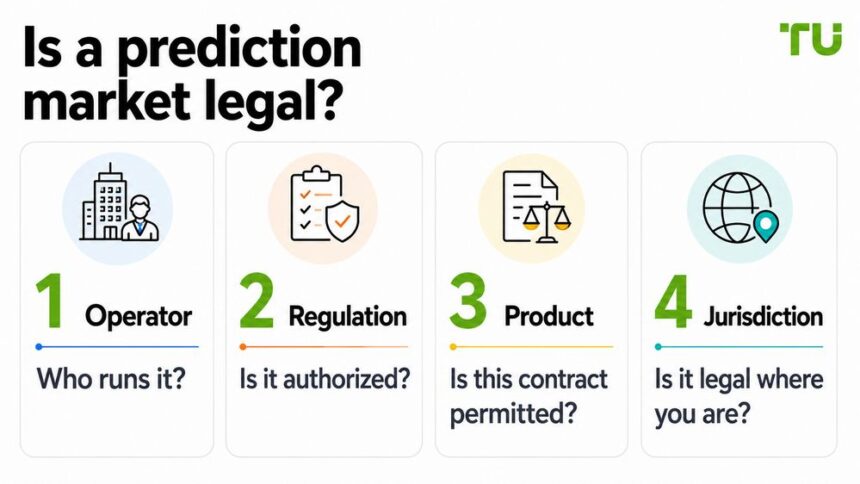
Are prediction markets legal in Canada?
The legality is complex and depends on the nature of the contract and your province. While the CSA has clarified that some event contracts are not securities, provincial gambling laws may still prohibit them.
Why do some firms want these markets regulated as derivatives?
Proponents argue that bringing these contracts under a derivative framework would provide a clear set of rules for consumer protection and market transparency. This would theoretically make the platforms safer for retail participants.
What is the biggest risk for a retail investor in these markets?
The primary risk is the lack of regulatory recourse. If a platform fails or engages in unfair practices, retail investors may have no legal mechanism to recover their losses.
For official investor guidance, see the Canadian Securities Administrators.