Prioritizing high-wage occupations in Express Entry is a necessary, data-driven evolution to ensure Canada’s immigration system directly fuels economic productivity and human capital growth. For too long, the system has relied on broad metrics that failed to distinguish between roles that provide immediate, high-value economic contributions and those that merely fill gaps without driving innovation. The stakes for this shift are massive. Canada faces a productivity crisis that threatens to undermine its standard of living and public service funding. By aligning immigration with high-wage roles, the government is finally signaling that it values economic impact over sheer volume. This policy is not just about filling vacancies. It is about building a workforce that can compete on a global scale. If Canada fails to capture top-tier talent, it will continue to lag behind its peers in technological advancement and industrial output. The transition to this new model will be complex, but the long-term benefits for the Canadian economy are undeniable. A Smarter Immigration Strategy for Canada’s Future
What happened
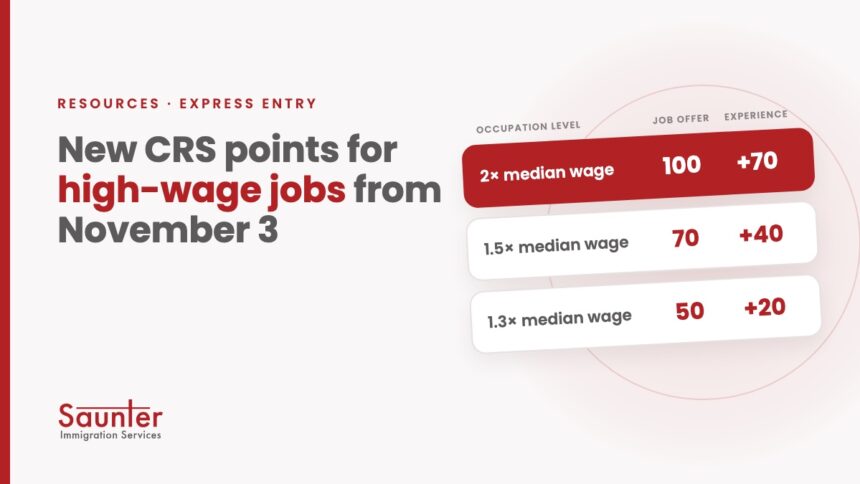
On October 16, 2026, Immigration Minister Lena Metlege Diab announced a fundamental shift in how Canada manages its Express Entry system. Effective November 3, 2026, the government will implement a new Labour Market Integration factor. This change awards significant additional Comprehensive Ranking System points to candidates who possess eligible Canadian work experience or hold qualifying job offers in high-wage occupations. The government defines a high-wage occupation as one where the median wage is at least 1.3 times the national median wage (Government of Canada, 2026). A critical component of this reform is the removal of the Labour Market Impact Assessment requirement for these specific qualifying job offers. This change is designed to reduce the administrative burden on employers who are trying to hire top-tier international talent. Candidates already in the Express Entry pool will have their scores automatically recalculated. To facilitate this transition, the government has announced that invitation rounds will be paused for up to two weeks starting November 3, 2026 (CTV News, 2026). The policy is explicitly aimed at sectors that drive economic growth, such as engineering, technology, and specialized skilled trades. As noted by the government, this is a strategic move to ensure that immigration outcomes are directly linked to the specific economic needs of the country (Government of Canada, 2026). Canada’s Immigration Dual Reality: Narrower Access, Persistent Demand

Why this matters
The pivot toward high-wage occupations represents a mature, necessary response to the economic realities of 2026. For years, Canada used a blunt instrument to manage immigration, focusing on numbers rather than the specific economic utility of the incoming workforce. This approach led to a disconnect where many immigrants struggled to find work that matched their skill levels, while critical sectors faced persistent shortages of high-level talent. By rewarding candidates in high-wage roles, the government is creating a direct incentive for the global elite to choose Canada. This is not about excluding others, but about ensuring that the people who enter the country are positioned to contribute to the economy from day one. Critics argue that removing the LMIA requirement risks wage suppression and undermines the protection of the domestic labour market. They contend that the LMIA process is the only way to verify that no qualified Canadians are available for these roles. While this concern is valid in principle, it ignores the reality of the current labour market. The administrative bottleneck of the LMIA process has often deterred employers from hiring the talent they desperately need. The government has clearly decided that the risk of a slightly faster hiring process is outweighed by the benefit of securing high-wage talent that can boost productivity. This is a calculated risk that reflects a shift from a social-service model of immigration to an economic-growth model. The argument holds because the productivity gap is the single greatest threat to Canada’s future prosperity. If the country cannot attract and retain the people who build the technologies and lead the industries of the future, no amount of general immigration will save its standard of living. As the government stated, the goal is to align immigration with economic outcomes, which is the only way to sustain the public services that Canadians rely on (Hindustan Times, 2026). Supporting economic growth and stronger public services by maximizing the contributions of temporary workers already in Canada
What readers should do
If you are an applicant or an employer, you must act now to prepare for the November 3, 2026, transition. The system is changing, and those who do not update their strategies will be left behind. Follow these steps to ensure you remain competitive under the new rules:
- Review your current job offer to determine if it meets the 1.3 times national median wage threshold for your specific occupation.
- Update your Express Entry profile immediately to ensure all work experience and wage data is accurate and ready for the automated recalculation process.
- Consult with your employer to confirm they are prepared to provide the necessary documentation to support your claim for the new high-wage points.
- Monitor the official IRCC website for the resumption of invitation rounds after the two-week pause, as the cut-off scores for the next round will likely shift significantly.
- If you are an employer, prepare to leverage the removal of the LMIA requirement for your high-wage hires to streamline your recruitment of international talent.
Candidates should not panic during the two-week pause in invitation rounds. This is a standard administrative adjustment. Use this time to verify your eligibility under the new criteria. The system is becoming more selective, and the reward for those who meet the high-wage criteria will be a faster, more certain path to permanent residence. The focus is now on quality and economic impact, and your profile must reflect that reality.
Frequently Asked Questions
Will my current Express Entry score change automatically?
Yes. The government has confirmed that all existing profiles in the Express Entry pool will be automatically recalculated to reflect the new points for high-wage work experience and job offers.
Can I combine the points for Canadian work experience and a qualifying job offer?
No. Candidates can earn up to 150 points for Canadian work experience or 100 points for a qualifying job offer, but the system does not allow you to combine both for a higher total.
How do I know if my job is considered high-wage?
A high-wage occupation is defined as one where the median wage is at least 1.3 times the national median wage. You should check the official government wage data for your specific occupation code to confirm your eligibility.